
Is there a photo sharing app for a more intentional group experience?
Yes, but “photo sharing” can mean very different things. Some services are designed for collecting, organising and viewing images whenever each person chooses. Others use photography as part of a shared moment: people take pictures, avoid seeing them immediately, and open the collection together later. The useful choice is not simply the app with the longest feature list; it is the format that fits the occasion and the group’s expectations.
If your group is asking “is there a photo sharing app” because casual photo exchanges feel scattered or overly performative, begin with the social problem rather than the technology. Do you need easy access to a growing archive, or do you want a short ritual that keeps attention on the event and turns the reveal into part of the memory? Those are related needs, but they call for different designs.
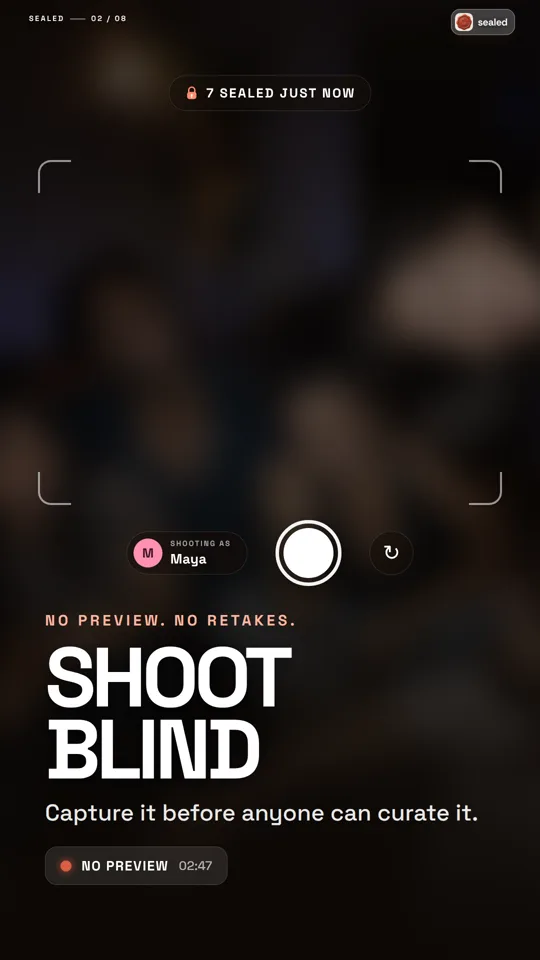
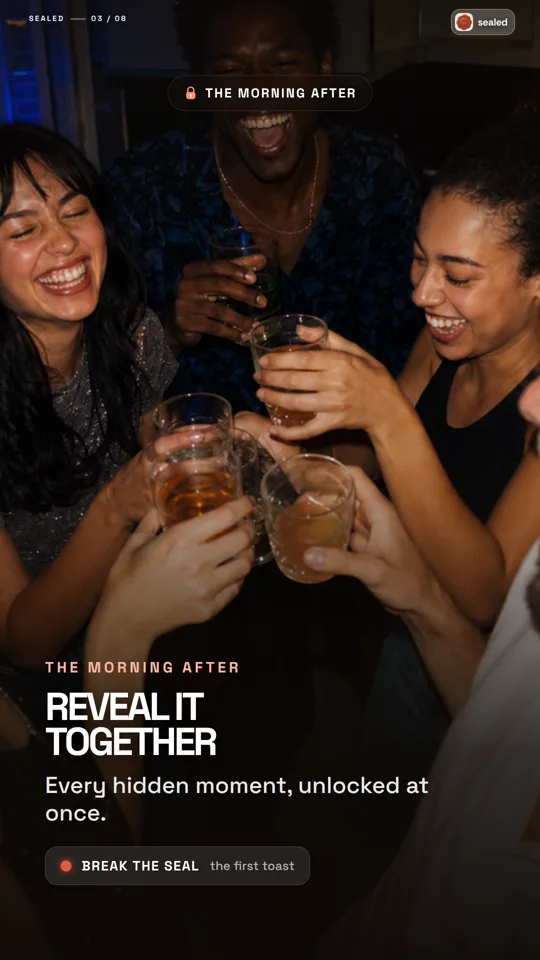
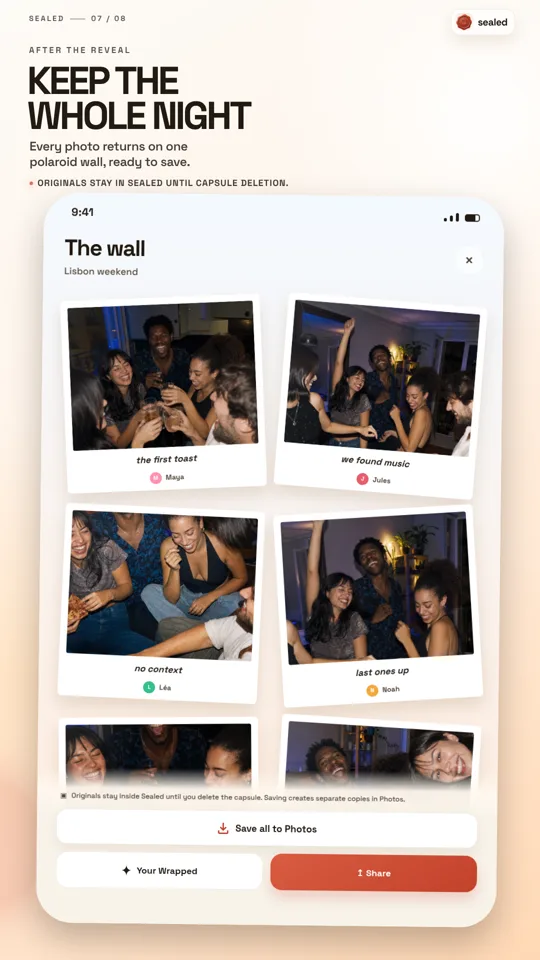
Sealed sits in the second category. Its public framing is a group photo capsule with a delayed collective opening, intended to support deliberate group photography rather than constant checking of what has just been captured. This article’s advice is therefore bounded by that public context: it is most relevant when shared anticipation and a considered reveal matter more than instant review.
Start with the purpose of sharing
A cloud-style shared album is often a sensible choice when the main goal is practical access. It can suit trips, family archives, projects, or events where people need to contribute and revisit photos over time. In that setting, immediate visibility may be helpful: someone can find a picture, add context, or download a copy without waiting for a group moment.
A delayed group capsule serves a different purpose. It creates a boundary around the taking of photos, so the camera does not automatically become a screen for reviewing, comparing or retaking every image. That boundary can reduce interruption during a meal, walk, celebration or gathering, provided the group actually wants that structure.
Neither approach is automatically more private, more meaningful or better for every event. A shared album can be thoughtful when contributors agree on how it will be used. A delayed reveal can be unhelpful if participants need access right away, if someone is uncomfortable with uncertainty about their image, or if the timing of the opening excludes people who should be included.
- Choose an ongoing album for access, collaboration and later retrieval.
- Choose a delayed capsule for a bounded occasion and a shared opening moment.
- Use both only when each has a clear role, such as a capsule for the event and an album for selected post-event keepsakes.
Consent matters before any sharing workflow
A photo-sharing app does not remove the need for participant consent. Before photographing or distributing images that make people identifiable, check that they are comfortable being included and understand the intended context. This is especially important for children, sensitive occasions, workplaces, private homes and groups with unequal power dynamics.
Consent is more useful when it is specific. “We are taking photos” is not always the same as “these images will be shown to everyone later,” “they may be added to an album,” or “they could be posted elsewhere.” Explain the plan in plain language, including whether the images are for the group only, how long the collection will remain relevant, and what someone can do if they prefer not to appear.
A delayed reveal should never be used to prevent a person from expressing a boundary. The ritual can be enjoyable precisely because everyone knows the rules in advance: no live preview pressure, no surprise public distribution, and a respectful route to remove or avoid an image when that is appropriate.
- Ask before capturing identifiable participants, not only before publishing.
- State who will see the photos and whether they may leave the group context.
- Offer an easy opt-out: step out of a shot, request deletion, or ask not to be included in later sharing.
How to decide whether a delayed reveal fits
The strongest sign that a delayed reveal fits is that the group values the event more than the immediate image. Friends at a dinner, reunion, birthday or weekend activity may enjoy discovering the photographs together because it extends the occasion without requiring people to inspect screens during it. The anticipation is shared, rather than becoming a private cycle of taking, checking and correcting.
It is less suitable when instant feedback is necessary. A person documenting an important practical detail, coordinating a visual task, or trying to ensure accessibility or safety may reasonably need to see the image at once. The same applies when attendees have different comfort levels with candid photography and the group has not made space for those concerns.
Think of minimal interruption as a design goal, not a rule that overrides people. If the process causes anxiety, confusion or pressure to participate, it is no longer serving the gathering. The right photo-sharing setup should make the group more present, not make them perform for the setup.
- Good fit: a voluntary social occasion with a clear group and a planned opening time.
- Questionable fit: unclear audience, mixed expectations, or a need for instant access.
- Poor fit: anyone has not consented, cannot reasonably join the reveal, or feels pressured to be photographed.
Example decision aid: a weekend dinner with eight friends
Example: eight friends are planning a dinner and want photographs without everyone passing phones around to inspect each shot. They agree beforehand that participation is optional, that identifiable photos stay within the group, and that they will open the collection together during brunch the next day. This is a plausible delayed-capsule use because the group is defined, the moment is social, and the reveal has a clear shared time.
Before starting, the host asks whether anyone prefers not to be photographed or wants limits on certain moments. One guest asks not to be included in candid close-ups, so the group honours that preference. The host also makes clear that the later opening does not mean automatic posting or forwarding: any broader sharing requires another conversation.
After the reveal, the group can decide whether a few mutually acceptable images belong in a longer-lived shared album. Separating the event ritual from later distribution helps preserve the thoughtful reveal while giving people a fresh opportunity to agree on what happens next.
- Before: define the group, the purpose, the opening time and the consent boundaries.
- During: keep capture lightweight and avoid interrupting the gathering for image review.
- After: treat any further sharing as a new choice, not an assumed consequence of participation.
Useful limits to keep in mind
No photo-sharing format can guarantee that every participant will experience a gathering the same way. A delayed opening may feel playful to one person and uncomfortable to another. Build in room for individual preferences, especially where someone may feel exposed, excluded or unable to attend the reveal.
Language is another practical limit. Editorial material in a given language does not prove that an app’s interface, support channels or current local store listing are available in that language. Before relying on a product for a group with particular language needs, check the current listing and the information available in your location.
Sealed’s public site provides privacy, terms and child-safety information, which are worth reviewing when those topics are relevant to your group. They are not substitutes for your own judgment about consent, appropriate audience and the nature of the event. The guiding idea is simple: use a tool to support shared anticipation and a considerate opening, while keeping people’s choices ahead of the ritual.
Frequently asked questions
Is there a photo sharing app that does not encourage instant previewing?
Yes. Some group photo formats delay access to images until a planned shared opening, which can reduce the habit of checking each photo immediately. Confirm the current product details and make sure all participants understand and agree to the arrangement.
Should everyone consent before photos are added to a group collection?
You should obtain consent before photographing or sharing identifiable participants, and explain who will see the images and how they may be used. Give people a practical way to opt out or request that an image not be shared.
Is a delayed photo reveal better than a shared album?
Neither is universally better. A delayed reveal can suit a voluntary social event where the group wants a collective ritual, while a shared album is often better for ongoing access, collaboration and finding photos later. Choose based on the occasion, consent and the group’s needs.
Sources and further reading
These resources provide the wider reference frame. Product statements on this page are limited to the public information provided by Sealed.