


What people actually mean by best free group photo sharing app
When someone searches for the best free group photo sharing app, they're rarely asking for a feature checklist. They're usually trying to solve a specific, recurring friction: a group of people took photos together, those photos are scattered across individual phones, and nobody wants to spend a week forwarding files or chasing permissions. 'Free' and 'group' are doing a lot of work in that phrase, and 'best' is inherently situational, so the honest starting point is defining what the search is trying to fix rather than ranking apps against each other.
There are at least two very different jobs hiding under this one query. One is logistics: get everyone's photos into a single shared place with minimal friction, ideally at no cost. The other is experience: how the group feels while photos are being taken and viewed, including whether people are checking their phones mid-event, editing on the spot, or waiting to see how a moment turned out until everyone can look together. A tool can solve the logistics job well and do nothing for the experience job, or vice versa, so it's worth deciding which one matters more before comparing options.
This is also where consent enters the picture in a way that's easy to skip past. A shared album is only as good as the group's agreement about who gets photographed, who gets tagged, and who gets to see or re-share images afterward. That agreement doesn't happen automatically just because an app makes sharing technically easy; it has to be discussed, even briefly, especially when the group includes people outside a close friend circle.
Free tiers: what to expect and what to verify yourself
Free group photo sharing apps typically monetize or limit usage in one of a few predictable ways: storage caps, resolution downgrades after a certain volume, ads, time-limited albums, or a ceiling on the number of contributors. None of these are inherently bad, but they matter differently depending on the group's size and how long the album needs to stay accessible. A weekend trip with six people has very different needs than a wedding with two hundred guests contributing photos over several months.
Because app pricing, storage limits and feature sets change frequently, the only reliable approach is to check the current store listing and app documentation for any tool you're considering rather than relying on secondhand claims, including anything in this article. What was free last year may now require a subscription for full-resolution downloads, and what was capped at a small number of photos may have since changed. This is a general caution that applies broadly, not a claim about any specific product's current terms.
A practical filter: before committing a group to a tool, have one person actually create a test album, invite two others, and confirm upload limits, download quality and expiration behavior firsthand. This takes five minutes and avoids the common failure mode of discovering restrictions after everyone has already contributed dozens of photos.
Where shared reveal changes the calculation
Most group photo apps are built around live sharing: someone takes a photo, it uploads, and anyone with access can see it within seconds. That model is genuinely useful for logistics, but it also creates a specific social dynamic where people start curating and reacting in real time, which can subtly change how a group behaves during the event itself. Some people slow down to check how a photo looks before moving on; others avoid being photographed candidly because they know it will appear immediately.
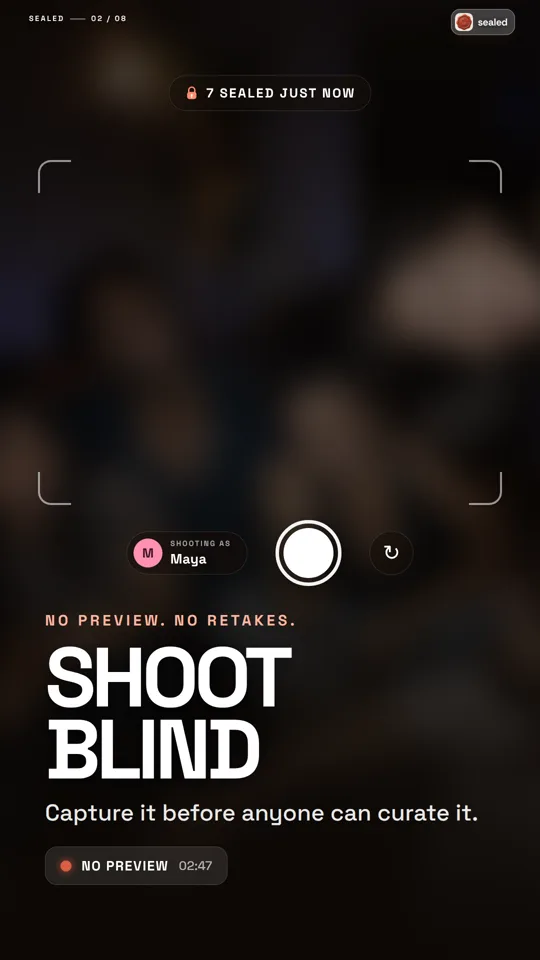
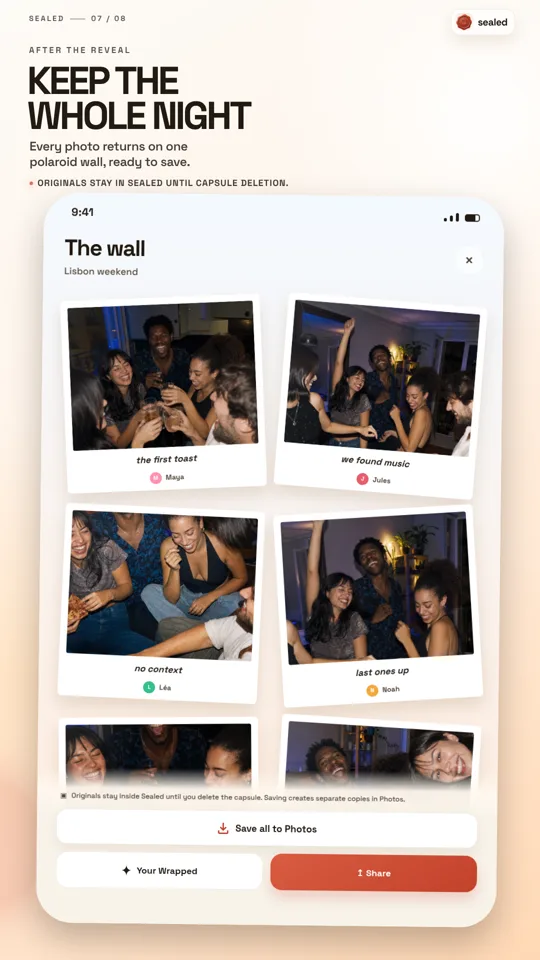
Sealed approaches this differently. It's built around the idea that everyone shoots, nobody peeks, and the group opens the capsule together later, so no one sees results until a shared reveal moment. This isn't a claim that delayed reveal is objectively superior to live sharing for every group; it's a different tradeoff aimed at people who want the photography itself to feel less self-conscious and more like a shared ritual than a live broadcast.
If the reader's actual problem is candid, unguarded photos and a sense of shared anticipation, a delayed-reveal model may address that better than a live album, even a well-organized one. If the reader's problem is purely 'get files off six phones and into one place quickly,' a conventional shared album is likely the simpler answer. It's worth being explicit that these are different products solving different problems, not competing on the same axis.
A worked example: choosing between two events
Consider two hypothetical scenarios to make the tradeoff concrete. Scenario A: a small group of five friends is meeting for a single afternoon hike and wants everyone's photos in one place by evening, with no particular concern about spoilers or reveal moments. Scenario B: a group of twelve friends is planning a surprise-themed weekend where part of the appeal is that nobody sees the collected photos until they're all back together afterward.
In Scenario A, the priority is speed and low friction - a conventional free shared album where photos upload as they're taken is likely the more practical fit, since there's no reveal moment to protect and everyone benefits from seeing photos accumulate live. In Scenario B, live uploads work against the intent of the event; a model where contributions are sealed until a set reveal moment better matches what the group actually wants from the experience, since the anticipation is part of the point.
This example is illustrative, not a recommendation for a specific app in either case - the right choice depends on group size, how long photos need to be stored, and whether anyone needs edit or export access before the reveal. The underlying question worth asking for any real event is simple: do we want to see these photos as they happen, or do we want to see them together, later?
A short decision checklist
Before picking any group photo sharing app, free or otherwise, it helps to walk through a short set of questions as a group rather than defaulting to whatever app someone already has installed. This avoids the common pattern of adopting a tool for one event and only discovering its limits - storage caps, missing consent controls, unclear deletion policies - after photos are already uploaded.
The checklist below is meant as a starting point for that conversation, not an exhaustive audit.
- How many people are contributing, and does the free tier's contributor or storage limit actually cover that?
- Does everyone in the group consent to being photographed and to those photos being visible to the whole group, or to anyone beyond it?
- Do we want photos visible as they're taken, or would a shared reveal moment fit the event better?
- How long does the album or capsule need to remain accessible, and what happens to it after that?
- Is there a way to confirm current pricing, storage limits and download quality directly in the app's own listing before committing the group to it?
Where to check the details, including for Sealed
Because this article avoids stating any competitor's current pricing or feature limits as fixed facts, and because app details change, the reader's next concrete step should be checking the current listing of any app under consideration, including confirming language and platform availability for their region. Editorial descriptions, including this one, don't guarantee that an app's interface, store listing or support matches a particular language or country; that has to be confirmed directly.
For readers specifically curious about Sealed's approach, the site includes a methodology page explaining how the shared-reveal model works, along with a guide comparing local photo capsules to cloud-based shared albums, which is directly relevant to the free-app comparison many readers are making. Sealed's public site also covers privacy, terms and child-safety information, which is worth reading before including minors in any shared photo group, regardless of which app is used.
None of this replaces the group's own judgment about consent, comfort with delayed versus live sharing, or tolerance for a given app's free-tier limits. The best free group photo sharing app, in practice, is the one whose actual current limits and reveal model match what a specific group of people actually wants from the event - which is something only that group can confirm firsthand.
Frequently asked questions
Is a free group photo sharing app always the right choice for a large event?
Not necessarily. Free tiers often cap storage, contributor counts or download resolution, and those limits can be reached quickly at larger events like weddings with many guests. It's worth testing the free tier with a small group first and checking the app's current listing for limits before relying on it for something with many contributors or a long storage window.
How is a shared-reveal photo app different from a regular shared album?
A regular shared album typically uploads and displays photos as soon as they're taken, so participants see results live. A shared-reveal model, like the one Sealed is built around, keeps photos hidden until everyone opens the capsule together later, which changes the experience from live sharing to a delayed group moment. Neither approach is objectively better; they suit different kinds of events.
What should a group agree on before sharing photos of each other?
At minimum, the group should agree on who consents to being photographed, whether those photos can be seen by everyone in the group or only some people, and whether images can be re-shared outside the group afterward. This matters regardless of which app is used, and is especially important when the group includes people outside a close circle or minors, since app privacy and child-safety policies vary and should be checked directly.
Sources and further reading
These resources provide the wider reference frame. Product statements on this page are limited to the public information provided by Sealed.