

Why 'party photo app free' searches rarely end at price
Anyone typing party photo app free into a search bar is usually trying to solve two problems at once: they want a low-cost way to collect photos from a group, and they want the experience to feel good in the moment rather than turning into everyone hunched over their own phone screens. The word 'free' signals budget sensitivity, but the underlying intent is almost always about the group experience - who takes the photos, when everyone sees them, and how much friction is involved.
This matters because free tiers of photo apps vary enormously in what they actually let a group do together. Some are essentially free storage with a shared album bolted on. Others are built specifically around a group ritual, such as a delayed and shared reveal, where nobody peeks at individual shots until everyone opens the results together. The free-vs-paid question is secondary to whether the app's core mechanic matches what the group actually wants from the night.
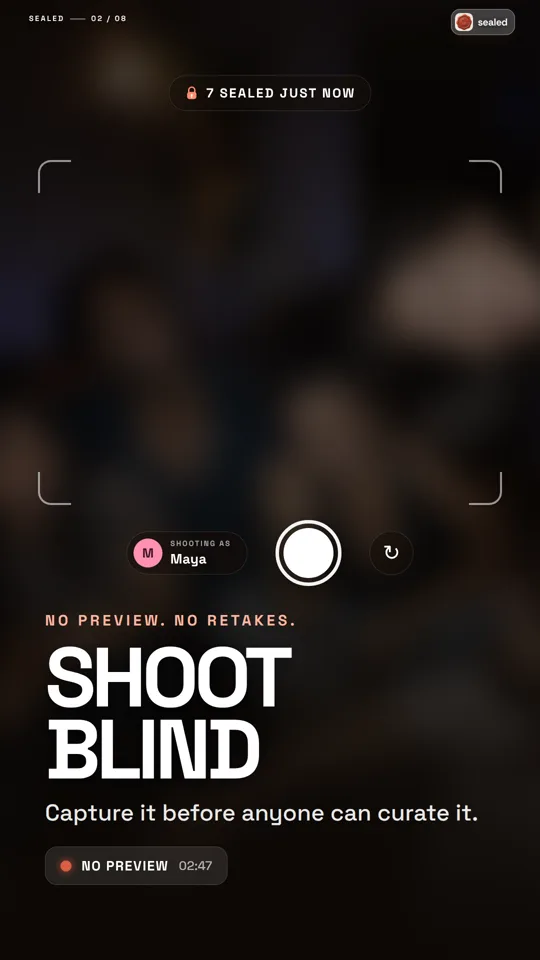
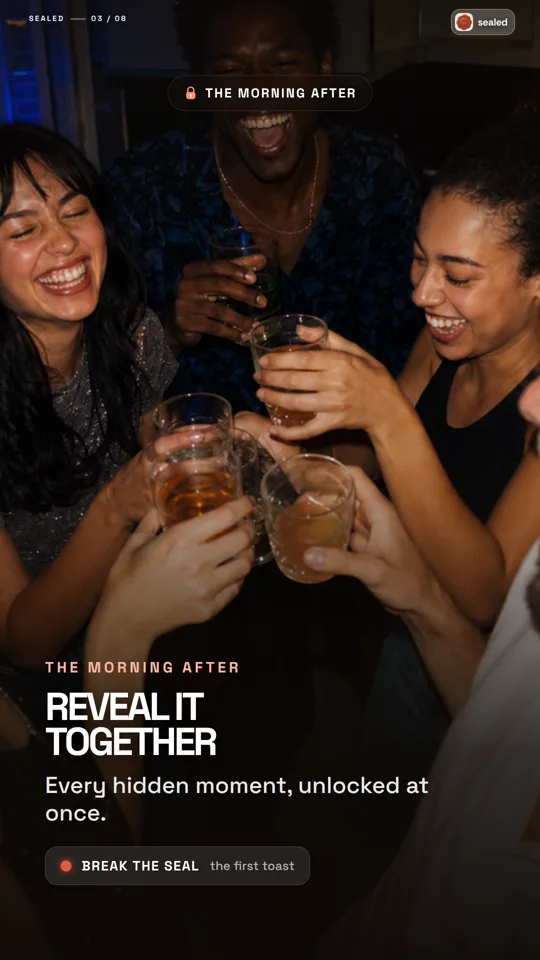
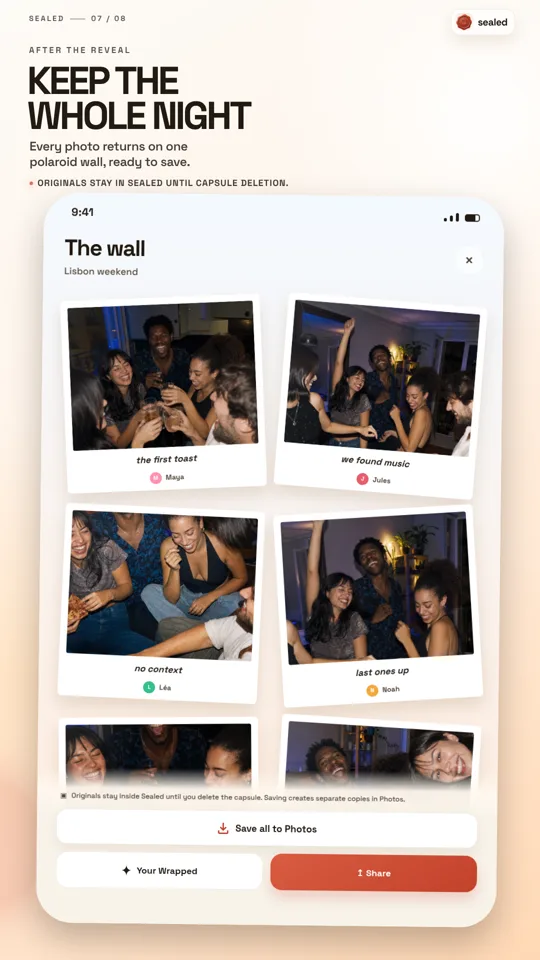
Sealed is one example of an app built around this second idea: a group photo capsule where everyone shoots, nobody peeks, and the group opens it together later. It is not built to be the cheapest option in every category, and this article does not claim that; it is built around a specific principle - delayed, shared reveal - that some readers searching for a free party photo app may or may not want.
The real trade-offs behind 'free'
Before comparing specific apps, it helps to separate three things that often get bundled under the single word 'free': the cost to download and use the app, the cost of storage once photos accumulate, and the cost of features like unlimited participants, high-resolution exports, or ad-free use. A party photo app can be free to install and still charge, limit, or otherwise gate any of these once a group's actual photo volume shows up.
Group events also generate photo volume unevenly. A birthday party or a wedding afterparty can produce hundreds of photos in a few hours from a dozen phones. Free tiers are frequently designed around individual use, not this kind of burst activity, so a plan that looks generous for one person's camera roll can feel restrictive once a dozen guests are all uploading at once.
A second trade-off is timing and control. Some free apps prioritize instant sharing - photos appear in a shared feed the moment they're taken. Others, including apps built around a delayed reveal model, intentionally hold photos back until a set moment. Neither approach is objectively better; they serve different kinds of parties. A surprise party or a slower, more intentional gathering may benefit from delay, while a fast-moving event may benefit from immediacy.
Consent is the part free apps often leave to the user
Whatever app a group chooses, the people in the photos deserve a say in whether they're photographed and whether those photos are shared further. This is true regardless of price. Free apps do not typically enforce consent on a host's behalf - it remains something the organizer and participants have to actively agree on, ideally before the first photo is taken.
In practice this means a simple conversation at the start of the event: who is comfortable being photographed, whether photos will be shared outside the immediate group, and whether anyone wants to opt out of specific shots being included. This is especially relevant at parties with guests who may not know each other well, or where some attendees may not want their image circulated beyond the room.
Sealed's public materials describe consent as a baseline expectation for anyone photographing or sharing identifiable participants, and this is a reasonable standard to apply no matter which app a group ultimately uses, free or otherwise.
A worked example: choosing for a 15-person birthday party
To make this concrete, consider a hypothetical: a host is planning a 15-person birthday dinner and wants a party photo app free option that lets guests contribute photos throughout the night, without everyone constantly checking their phones for new uploads.
In this example, the host would want to weigh a few things before picking an app: whether the free tier realistically supports 15 simultaneous contributors without a per-person paywall, whether photos are visible instantly (which can pull attention away from the table) or held for a later group reveal (which may suit a dinner setting better), and whether there's a clear point in the evening - like dessert - where a shared reveal moment would fit naturally.
This is a hypothetical illustration, not a tested outcome or recommendation for a specific product. The point is that the right choice depends on the shape of the event - headcount, pacing, and whether a delayed reveal adds to or detracts from the evening - more than on which app has the lowest listed price.
- Estimate rough photo volume: guests × likely shots per person, to sanity-check free storage limits
- Decide upfront whether the group wants instant sharing or a delayed group reveal
- Agree on consent basics before the event starts, not after photos are already circulating
- Identify one clear moment in the event where a reveal or recap would feel natural
What editorial language can and can't tell you about availability
When researching a party photo app free option, it's worth remembering that an article written in one language, or translated for a particular market, does not guarantee that the app's interface, its store listing, or its support is available in that same language. Store listings and app functionality can differ by region and change over time, independent of what an editorial page says.
Similarly, features described publicly - free tiers, storage caps, participant limits - are the kind of details that change as apps update their offerings. Readers evaluating any party photo app, including Sealed, should check the current store listing in their region before assuming a specific limit or price still applies.
This is a general caution that applies across the category, not a claim specific to any single app's reliability or trustworthiness.
A short checklist before you commit to a free app for your party
Rather than choosing based on price alone, it helps to run through a short set of practical questions before the event, since switching apps mid-party is disruptive and often impossible once photos have already been taken.
This checklist is meant as a starting point for discussion among hosts and guests, not a guarantee that following it will produce a particular outcome.
- Does the free tier support your expected guest count without hidden per-person costs?
- Is the reveal model (instant vs. delayed/shared) a good match for the type of event?
- Has the group agreed on consent - who's comfortable being photographed and shared?
- Have you checked the current regional store listing for actual pricing and features?
- Is there a clear, low-effort way for less tech-savvy guests to participate?
Frequently asked questions
Is a party photo app free option always cheaper than a paid one in practice?
Not necessarily. Free tiers often cap storage, participant numbers, or resolution, so a group with heavy photo volume may hit limits that make an upgrade effectively necessary. It's worth checking the current terms of any specific app before assuming the free version will cover a full event.
What's the difference between an instant-sharing photo app and one built around a delayed reveal?
Instant-sharing apps show photos in a shared feed as soon as they're taken, which suits fast-moving events. Delayed-reveal apps, such as Sealed's group photo capsule concept, hold photos back so everyone shoots without peeking and opens the results together later, which suits events where a shared reveal moment adds to the experience.
Who is responsible for getting consent from people in party photos?
Consent is the responsibility of whoever is taking or sharing the photos, not something a free app automatically manages. Hosts and photographers should agree with participants beforehand about whether they're comfortable being photographed and whether those photos will be shared further.
Sources and further reading
These resources provide the wider reference frame. Product statements on this page are limited to the public information provided by Sealed.