


What people actually mean by a free picture sharing app
When someone searches for a free picture sharing app, they are usually trying to solve a coordination problem: a group of people took photos at the same event and now needs one place to see them all, without paying for something they'll only use once or twice. The word 'free' is doing a lot of work in that search, because it can mean anything from a permanently free tier with limits, to a free trial that converts to a subscription, to an ad-supported service that monetises attention or data instead of money.
Before picking a tool, it helps to separate two different jobs that often get bundled under the same label. One job is simple transfer: getting photos from several phones into a single folder or album. The other job is shared experience: giving a group a moment where they look at the photos together, rather than each person scrolling through a feed alone at different times. Many apps are built for the first job. Fewer are built deliberately for the second.
- Ask whether you need storage, transfer, or a shared viewing moment
- Check if 'free' means a permanent tier or a time-limited trial
- Note who can see the photos by default: just the group, or a wider network
Consent and identifiability come before convenience
Any discussion of a free picture sharing app has to start with consent, because group photos usually contain identifiable people who did not individually agree to how far their image travels. Getting consent before photographing or sharing identifiable participants is a baseline expectation, not an optional extra, and it applies regardless of which app or price tier is involved.
In practice this means thinking about defaults before you think about features. Does the app share to a public link by default, or does it require an explicit invite? Can any participant remove themselves or a photo of themselves after the fact? Does the group know, before shooting starts, where the photos will end up and who else might see them? These questions matter more than storage limits or filter options, because they determine whether the experience feels respectful or extractive.
Sealed's editorial position treats consent as one of the required principles behind any group photo ritual, alongside shared anticipation, minimal interruption, and a thoughtful reveal. Those principles are a lens for evaluating tools, not a claim that any particular free app follows them.
Local capsule versus cloud shared album
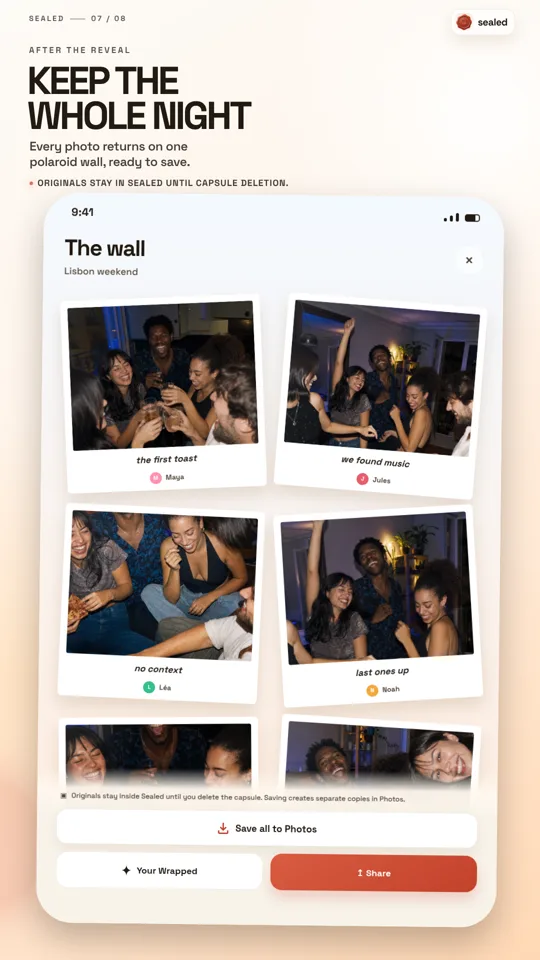
A meaningful distinction in this space is between a local, contained photo capsule and an open-ended cloud shared album. A local capsule model, as described in Sealed's own guide comparing the two approaches, gathers photos into a self-contained set for a single occasion, often with some form of delayed or gated reveal, and does not keep expanding as new content is added indefinitely. A cloud shared album is typically an ongoing, growing folder that anyone with access can add to or view at any time, with no particular moment of 'opening' it together.
Neither approach is objectively better; they suit different situations. A cloud album fits an ongoing group, like a family that keeps adding photos over years. A capsule model fits a bounded occasion, like a single trip, wedding, or party, where the group wants one collective moment of seeing everything rather than a live trickle of images as they're taken.
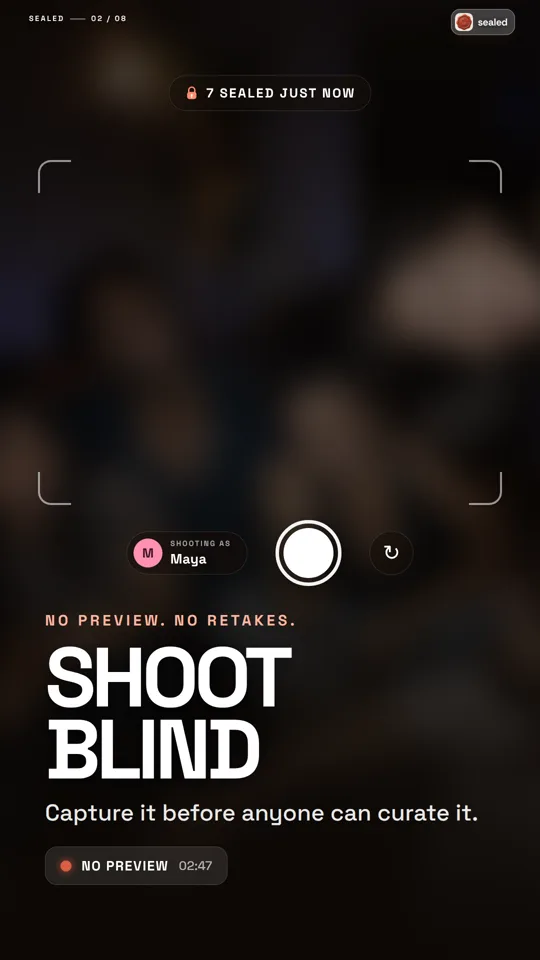
Sealed itself is built around the capsule idea: everyone shoots, nobody peeks, and the group opens it together. That is a specific design choice, not a claim that it is the only valid way to share group photos, and it's worth naming here because it directly informs the checklist below.
A worked example: choosing for a weekend trip
Here is a hypothetical, for illustration only, not a report of an actual test or outcome. Imagine a group of six friends going away for a weekend. They want photos from everyone's phones, they don't want anyone posting mid-trip, and they want a single moment at the end where everyone looks at the results together.
Walking through the decision: first, they'd check whether the free tier of any candidate app covers six contributors and however many photos a weekend typically produces, since limits on people or storage often appear at exactly this scale. Second, they'd check the default visibility setting, confirming photos aren't public or discoverable by non-participants. Third, they'd look at whether the app supports any form of delayed or gated viewing, since their goal is a shared reveal rather than a live feed. Fourth, they'd confirm each person can consent to their own likeness being included and can ask for a photo to be removed.
In this hypothetical, a capsule-style app with a genuine reveal mechanism would fit their stated goal better than a standard cloud album that shows photos as soon as they're uploaded, because the group's explicit priority was the shared moment, not real-time access.
A practical checklist before you commit
Because 'free picture sharing app' covers such a wide range of tools, a short checklist is more useful than a single recommendation. Use it to compare whichever specific apps you're actually considering, since features and pricing on any given app can change and should be verified on the current store listing rather than assumed from an old review.
The checklist below applies the required principles of shared anticipation, participant consent, minimal interruption, and thoughtful reveal as evaluation criteria rather than marketing language.
- Confirm what 'free' includes today: contributor limits, storage caps, or a trial window
- Check default sharing scope: private to the group, or open link
- Ask if the app interrupts the moment (constant notifications, live previews) or lets people shoot without checking a feed
- Look for a genuine reveal mechanism if a shared moment matters to your group, versus a simple running album
- Verify removal or opt-out options for any participant
- Check the app's privacy, terms and child-safety information directly rather than assuming
Where Sealed fits, and where it doesn't
Sealed is a group photo capsule built around delayed, shared reveal: everyone shoots, nobody peeks, and the group opens it together. That design serves groups who want the checklist items above bundled into a single ritual, particularly the combination of minimal interruption during shooting and a thoughtful, collective reveal afterward. The public site includes privacy, terms and child-safety information for anyone evaluating it against the checklist.
This article is not a claim that Sealed is the only or best free picture sharing app, and it does not report any first-party testing, benchmarking, or customer experience. Any specific claim about current pricing, availability, or feature set for Sealed or any other app should be checked against that app's current store listing, since these details change over time and editorial translations of a site do not guarantee the app interface or support is available in the same language.
Frequently asked questions
Is a free picture sharing app really free, or are there hidden costs?
It depends on the specific app and can change over time. 'Free' commonly means a permanently limited tier, a time-limited trial, or an ad-supported service. Always check the current store listing or app description for the specific limits and what happens once you exceed them, rather than assuming a fixed meaning of 'free.'
How do I get consent before sharing group photos?
At minimum, tell participants before shooting that photos will be shared, where they'll be shared, and who can see them, and give people a clear way to opt out or ask for removal afterward. This applies regardless of which app is used, and is especially important for identifiable faces or minors, where extra care and any applicable child-safety guidance should be followed.
What's the difference between a photo capsule and a shared album?
A photo capsule is typically a bounded, self-contained set of photos tied to one occasion, often with a delayed or gated reveal so the group sees everything together at once. A shared cloud album is usually an ongoing, growing collection that updates continuously and has no defined 'opening' moment. Which one suits you depends on whether you want a single shared moment or continuous, ongoing access.
Sources and further reading
These resources provide the wider reference frame. Product statements on this page are limited to the public information provided by Sealed.