
Are disposable cameras worth it? Start with what you want from the photos
Whether disposable cameras are worth it depends less on the camera than on what you expect from the pictures. A single-use film camera gives you a fixed number of exposures, no screen to check and a wait between taking a shot and seeing it. Some people value exactly those limits. Others find them a frustrating way to lose a moment that only happens once.
Before buying, separate three goals that often get blended together: the look of film, the experience of shooting without checking, and the shared moment of seeing the results later. A disposable camera delivers all three, but each one comes with its own cost and limits. If only one of them really matters to you, there may be a simpler route.
This article comes from the editors of Sealed, a group photo app built around a delayed reveal, so our angle is intentional group photography rather than camera gear. We do not review film stock or compare camera models, and we have not run tests. The guidance below is practical reasoning you can check against your own plans.
What a disposable camera genuinely does well
The strongest case is about behaviour. With no preview, people stop curating every frame, nobody gathers around a screen to approve a group shot, and the event keeps moving. That lack of interruption is often what people mean when they say a film camera made a party feel different.
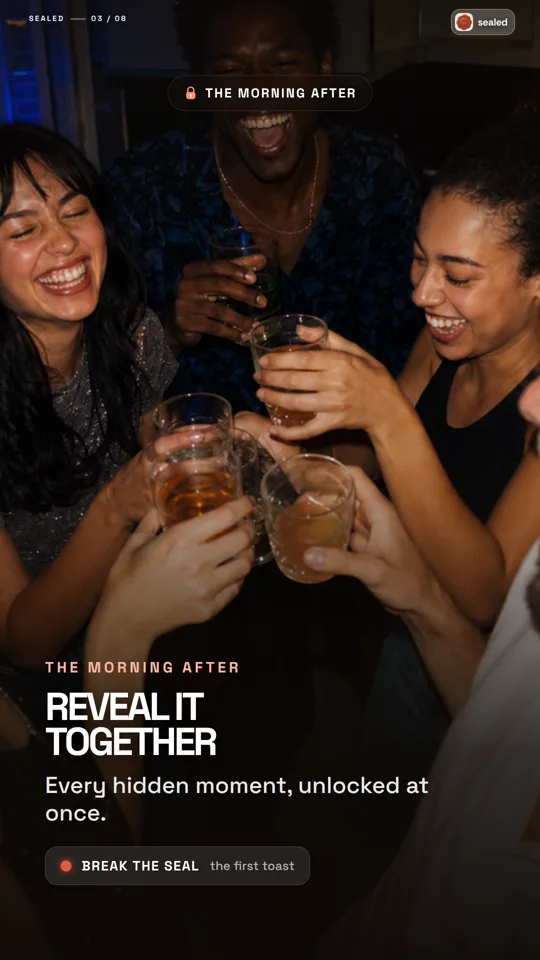
The second strength is anticipation. Because the results arrive later, the photos become a small event of their own. Passing prints around or opening a batch of scans together turns a set of snapshots into a shared memory instead of another scroll through a camera roll.
Finally, a limited number of exposures encourages people to think before pressing the shutter. That constraint can produce fewer but more deliberate pictures. It can also mean missing something you would have caught easily on a phone.
The limits worth weighing before you buy
The cost goes beyond the camera itself. Developing and scanning are usually separate steps, and prices and turnaround times vary by lab and region, so check current local options rather than assuming. Simple fixed-lens cameras also tend to struggle with low light, fast movement and dim indoor scenes, which matters if most of your event happens in the evening.
Groups face a practical reveal problem too. If several guests carry cameras, someone has to collect them, take them to be developed and then share the results, which can stretch over weeks and leave out anyone who is no longer around. Single-use cameras also create physical waste, which some groups weigh against occasional use.
- A fixed exposure count with no way to delete a bad shot
- Development and scanning add both time and expense
- One person usually ends up coordinating collection and sharing
- Weak or blank shots are only discovered after the event
Consent and privacy apply to film and digital alike
Shooting without a preview does not remove responsibility. Candid frames feel spontaneous precisely because people are not posing, which also means they may not realise they are being photographed. Ask before photographing identifiable people, and ask again before sharing any image beyond the group that took it.
Think about where the images will end up. Prints sit in one person's drawer, scans may be uploaded to a lab or cloud folder, and app photos may stay on a phone or be stored on a server. Knowing which applies lets you tell guests honestly what will happen to their pictures. Images of children deserve extra care, so read the privacy and child-safety information for any tool you use.
A phone-based option for the shared-reveal part
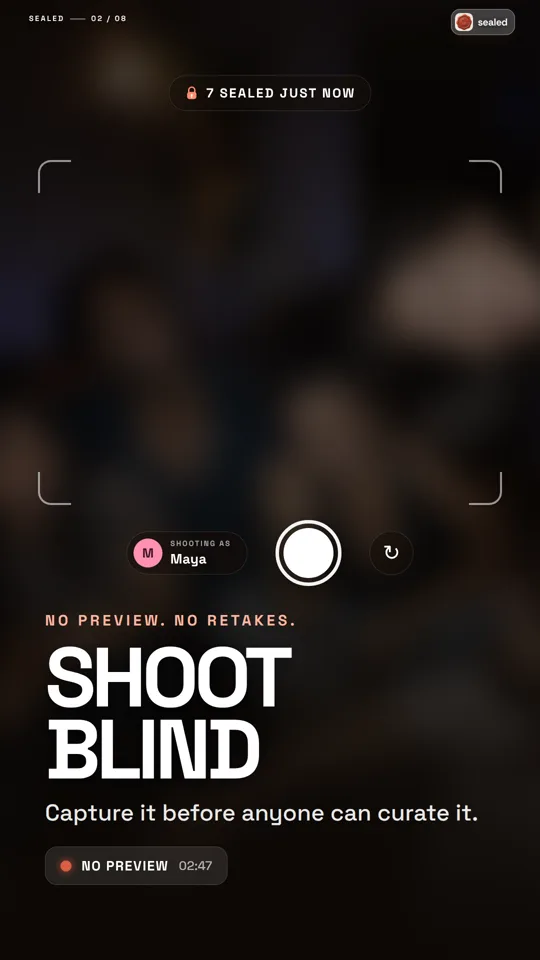
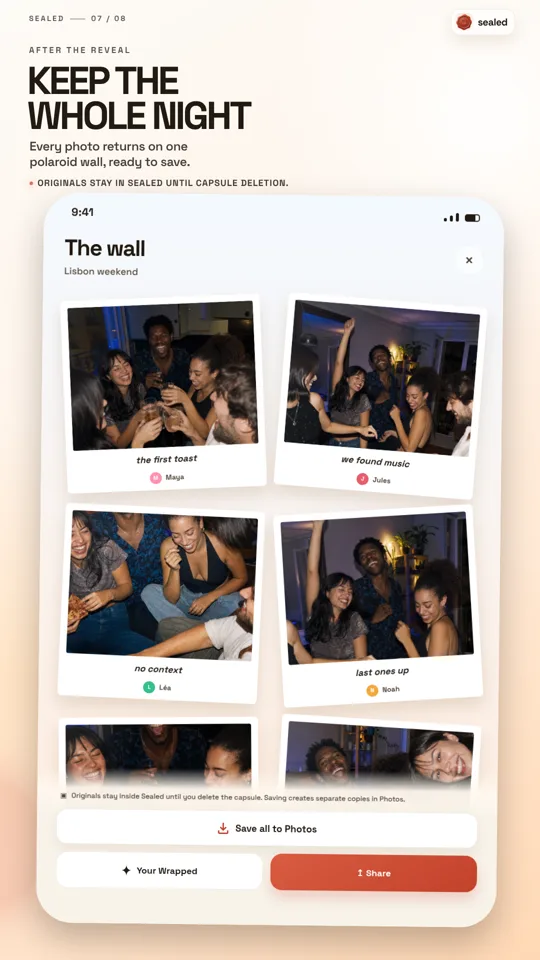
If you mainly want the experience rather than the film look, a phone app can recreate the core constraint. In Sealed, every shot goes directly into a sealed capsule with no preview, retakes, filters or camera-roll imports, and even the person who set it up cannot see anything early. The creator picks an opening time between roughly six hours and a week, after which the group watches a reveal set to music, followed by a wall of every photo.
This covers anticipation and minimal interruption, but it gives you no physical prints or film grain, and it has its own limits. Everyone who shoots needs the app, though an account is optional. A local capsule keeps photos on a single phone, while a shared capsule uploads them for members and removes the server copies 30 days after opening, so people should save the pictures they want. Our guide comparing local photo capsules with cloud shared albums explains those trade-offs in more detail.
Example decision checklist: a weekend away with friends
Example, hypothetical: six friends plan a weekend trip and want photos that feel less staged than usual. Before deciding between disposable cameras and a phone capsule, they work through the questions below together rather than leaving the choice to one person.
In this example, if the group wants physical prints and one friend is happy to handle developing, disposable cameras are worth it. If they mainly want the shared surprise, expect a lot of dim evening scenes and nobody wants to coordinate a lab visit, a phone-based capsule may suit them better. Either way, they agree on consent and sharing rules before the first photo is taken.
- Do we want prints we can hold, or is seeing the photos together enough?
- Who will collect, develop and share the results, and how long can we wait?
- Will most moments happen outdoors in daylight or indoors at night?
- Is everyone comfortable being photographed candidly, and where may photos be shared?
- Where will the images be stored afterwards, and who keeps the copies?
Frequently asked questions
Are disposable cameras worth it for a wedding or party?
They can be, if guests enjoy shooting without a screen and someone is willing to collect the cameras, arrange developing and share the results afterwards. The main drawbacks are development cost and delay, weak results in low light, and possible blank or unusable frames. Check current local lab prices before buying several cameras.
Do disposable camera photos look better than phone photos?
They look different rather than objectively better. Film from a simple single-use camera has a distinctive softness, grain and colour that many people like, but it is usually less sharp and less reliable in dim or fast-moving scenes than a modern phone. Choose based on the look and experience you want.
Can I get the disposable camera experience without buying film?
Yes, some phone apps hide photos until a set time so a group can shoot without previews and see everything together later. Sealed is one example: it is free on the App Store for iPhone and on Google Play for Android, and everyone who shoots needs the app installed. It does not produce physical prints or a film look.
Sources and further reading
These resources provide the wider reference frame. Product statements on this page are limited to the public information provided by Sealed.