


How to have wedding guests upload photos: decide what you are collecting
If you are working out how to have wedding guests upload photos, start with a question many couples skip. Do you want the pictures guests take during the day, or every picture they happen to have on their phones afterwards? These lead to different tools, different instructions and different reliability problems. A method that is good at one is often awkward at the other.
Guest photos rarely replace a professional photographer. They add the angles a photographer never sees, like the table jokes, the dance floor at midnight and the getting-ready chaos. Treating them as a supplement helps you choose something light enough that guests actually use it, rather than something comprehensive that nobody opens after the first drink.
Choose a collection method that fits how guests behave
There are broadly three approaches. A shared cloud album or folder, often reached by scanning a QR code on each table, lets guests add photos already in their camera roll, before or after the event. A dedicated event app asks guests to install something but can shape how they shoot. A designated collector, usually a friend who gathers files after the wedding, needs no technology from guests but depends on one person's follow-through. Features, pricing and limits of any third-party service change, so check them close to the date rather than relying on an old recommendation.
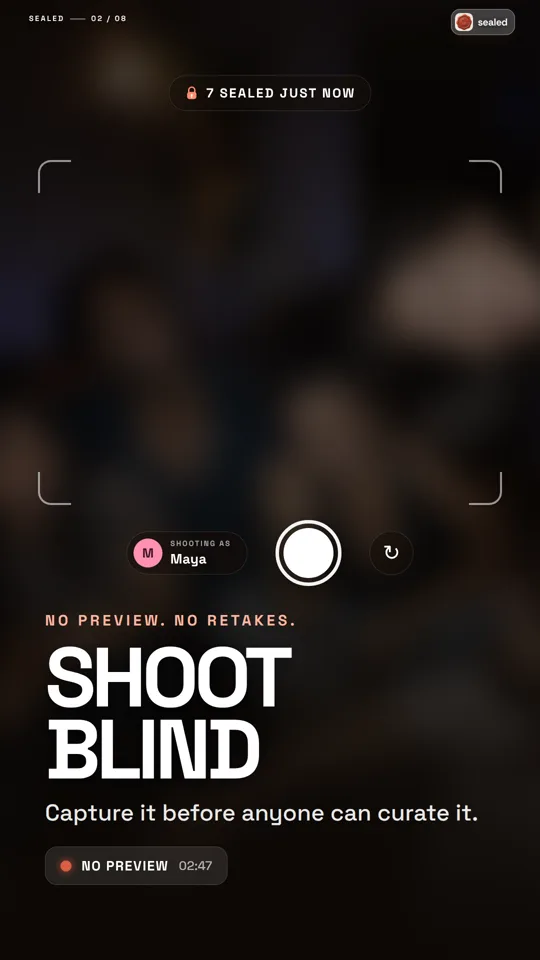
Sealed sits in the second group, and it has a clear size limit: it is designed for a group of up to 30 guests joining one capsule. At a larger wedding, that makes it a fit for a subset, such as the wedding party or one table group, rather than the whole guest list. Members join on their own phones with a six-character code or a sealedreveal.com/j/ link, take pictures inside the app, and nobody, including the couple, can see them until the opening time you set.
Because shots go straight in without previews or camera-roll imports, Sealed suits in-the-moment shooting and shared anticipation, not gathering photos people took elsewhere. If you need both, or have more guests than one capsule fits, pair it with a simple shared folder for everyone else.
Brief guests with minimal interruption
The biggest cause of a thin collection is often not the tool but the explanation. Guests are busy, and a three-step instruction card competes with speeches, food and conversation. Reduce the ask to one sentence and put it where people pause: welcome signs, table cards and the bar. For a shared folder, that might be 'Scan the QR code and add your photos any time this week'. For a Sealed capsule, it would be 'Open Sealed, enter the code on this card, and shoot until midnight'.
Timing matters too. Announce it once, early in the reception, rather than repeatedly. Ask a friend who is comfortable with phones to help less confident guests join, so the couple is not doing tech support in their wedding clothes. If the ceremony is unplugged, say clearly when photos are welcome, so guests are not unsure when the camera should come out.
Build consent into the plan, not the cleanup
Wedding photos capture people who did not choose to be in them: children, guests who prefer not to appear online, staff and vendors. Before anyone uploads anything, set a simple norm that guests ask before photographing someone identifiable up close, and that the collection stays among those invited unless subjects agree otherwise.
Do not count on a review step to catch problems. With Sealed there is no remote host moderation: the couple cannot screen photos before the opening, and once the capsule opens every member can view everything in it. Consent therefore has to happen at the moment of shooting, and the capsule should only include people you are comfortable seeing the whole set. Agree in advance how you will respond if someone later asks that an image not be shared further.
Sealed's public site includes privacy, terms and child-safety pages worth reading before you invite guests. For specific legal questions about photographing people, take advice locally rather than relying on any app guide.
Reliability checks before, during and after
Most failures are predictable: a venue with poor signal, a join link that only works on one type of phone, an opening time set wrong, or photos that vanish because nobody downloaded them. A short checklist run a week before the wedding catches most of these.
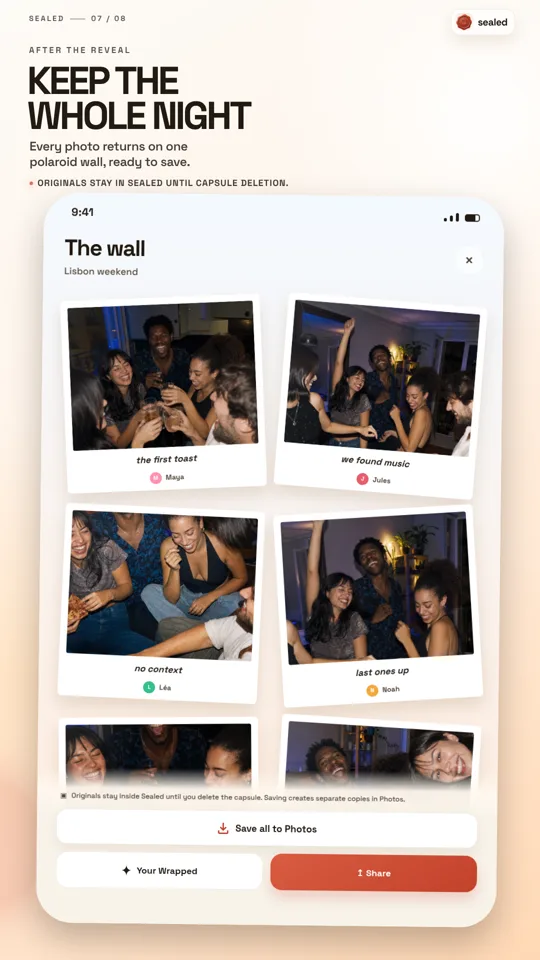
Retention is the check people forget. Many services limit how long files are kept. With Sealed, server copies of a shared capsule's photos are deleted 30 days after it opens, so assign one person to save the full set promptly rather than assuming it will always be there.
- Test joining on both an iPhone and an Android phone, using the exact Sealed code or link guests will see, and test any shared-folder QR code separately.
- Count who will join the capsule and keep it to 30 people or fewer.
- Check mobile signal and venue Wi-Fi in the rooms where people will actually shoot.
- Confirm the closing or opening time, including the time zone.
- Decide who downloads and backs up the collection, and by when.
- Keep a fallback, such as a shared folder, for guests outside the capsule or who cannot install an app.
- Tell guests whether they need an account.
Example: a worked hypothetical for a Saturday wedding
Example only, not a real event: a couple expects around 80 guests at a Saturday wedding with an unplugged ceremony and a Sunday brunch. Because one capsule fits up to 30 people, they create a shared Sealed capsule for the wedding party and closest friends, about 25 people, and hand them the six-character code on a small card. The capsule opens at Sunday 11:00, within the roughly six-hour to one-week window the app allows. Every table also gets a QR code for a shared folder, so the remaining guests can add camera-roll photos.
At brunch, the capsule group opens it together and watches the reveal, followed by a wall of every shot. That evening, a cousin saves the full set to the couple's own storage and gathers the shared-folder uploads alongside it. The trade-off is deliberate: less control during the day, with no way to screen capsule photos before they open, in exchange for a thoughtful reveal among a close group and nothing to curate mid-celebration.
Frequently asked questions
Can wedding guests upload photos they already took with their phone's camera?
It depends on the tool. Shared cloud albums and folders usually accept existing camera-roll photos. Capsule-style apps such as Sealed only include pictures taken inside the app, so couples who want both often add a simple shared folder for camera-roll uploads.
How do wedding guests join a Sealed capsule, and how many can join?
Guests need the Sealed app, which is free on the App Store and Google Play, but an account is optional. They join with a six-character code or a sealedreveal.com/j/ link. One capsule is designed for up to 30 people, so larger weddings often use it for the wedding party and a shared folder for other guests.
How long are guest wedding photos kept after a shared reveal?
Retention varies by service, so check before the wedding. In Sealed, server copies of shared capsule photos are deleted 30 days after the capsule opens, so someone should download and back up the photos the couple wants to keep.
Sources and further reading
These resources provide the wider reference frame. Product statements on this page are limited to the public information provided by Sealed.