
Why couples ask about wedding photo sharing without app
When couples search for wedding photo sharing without app, they are usually trying to solve a specific tension: they want the candid, varied perspective that guests capture, but they don't want to force every attendee to download software before they can participate. That's a reasonable instinct. Any tool that adds friction at the door of a wedding - a QR code nobody scans, an app store prompt during cocktail hour - reduces the number of guests who actually contribute photos.
The honest answer is that 'without app' rarely means 'without any coordination.' It usually means choosing a lighter-weight method: a shared cloud folder, a printed card with an email address or upload link, or simply asking guests to text photos to a designated person after the event. Each of these has tradeoffs in organization, privacy and how photos eventually get shared back with the group.
It's worth separating two goals that often get merged: collecting photos, and revealing them. Collection is about making it easy and low-pressure for guests to hand over what they shot. Reveal is about how and when those photos come back together for the couple and guests to see. Solving one doesn't automatically solve the other.
Options for collecting photos without a dedicated app
Cloud folder links (shared albums via a photo service, or a generic shared drive) are the simplest no-app option. Guests upload directly from their phone's browser or native camera roll. The tradeoff is organization: without structure, folders fill with duplicates, blurry shots and no way to know who took what, which matters if you later want to credit or contact someone about a specific photo.
Email or text-based collection works well for smaller weddings. A printed card with 'send us your favorites here' is low-tech and universally understood, but it depends on guests remembering to do it after the event, when attention has moved on. Response rates tend to drop the more time passes between the moment and the ask.
A hybrid approach - a physical prompt at the venue paired with a simple, no-login upload page - tends to capture more photos than either method alone, because it reduces the guest's decision-making at the moment they'd otherwise put the phone away.
- Shared cloud folder: low setup, weak organization
- Email/text collection: familiar, but relies on guest follow-through
- Printed card + simple upload link: best mix of ease and response, still no dedicated app install required
Consent and the wedding photo sharing without app search query
Whatever method is chosen, consent is not optional, and it doesn't disappear just because there's no app involved. Wedding guests are often photographed alongside people they don't know - other guests, children, vendors - and those people haven't necessarily agreed to have their image collected, stored or shared beyond the day itself. A no-app approach can actually make this harder to manage, since there's no built-in mechanism to ask or record consent before an upload happens.
A practical baseline: identifiable people in a photo should have some reasonable expectation that it might be shared, and anyone photographing should avoid publishing or forwarding images of people who've clearly indicated they don't want to be photographed. This is especially relevant for photos involving children, where a parent or guardian's comfort should guide what gets shared beyond the immediate group.
If photos are destined for a public album, social post, or vendor portfolio - as opposed to just a private family folder - that's a meaningfully different sharing decision than passing photos among people who were already at the event, and couples should treat it as one.
Timing: why some couples deliberately delay the reveal
Not every couple wants photos to surface immediately. Live photo sharing - guests posting during the ceremony or reception - can undercut the moment: people watch the day through a phone screen searching for their own good angle, and the couple sees fragments and reactions in real time rather than experiencing a coherent reveal later.
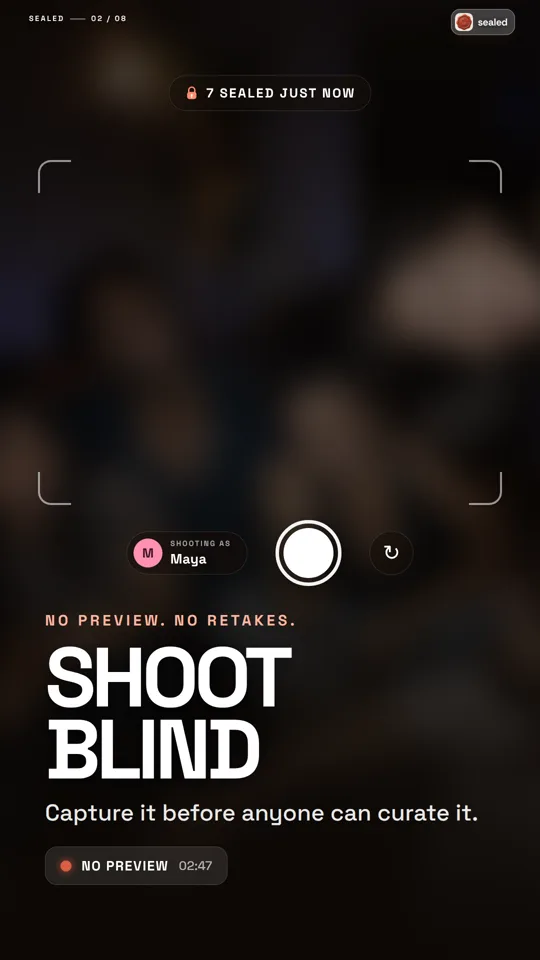
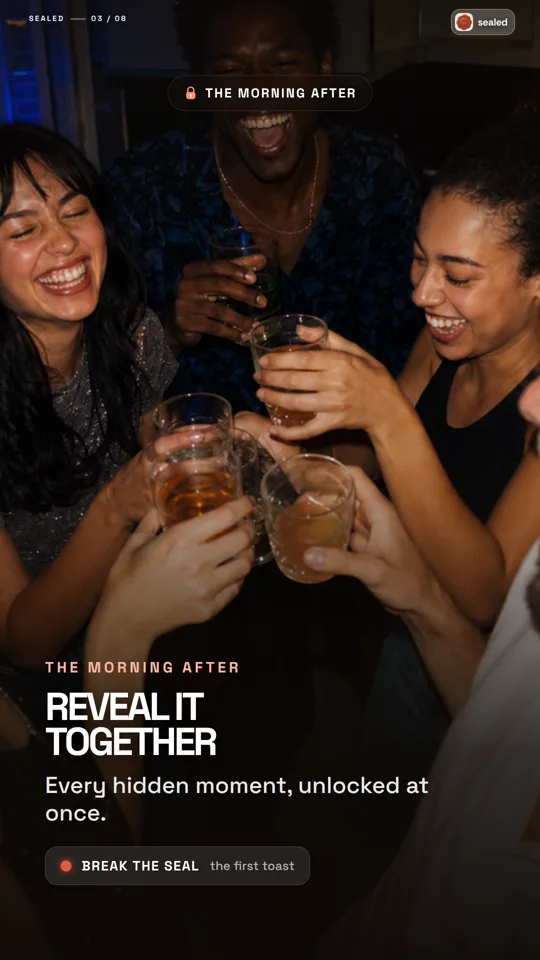
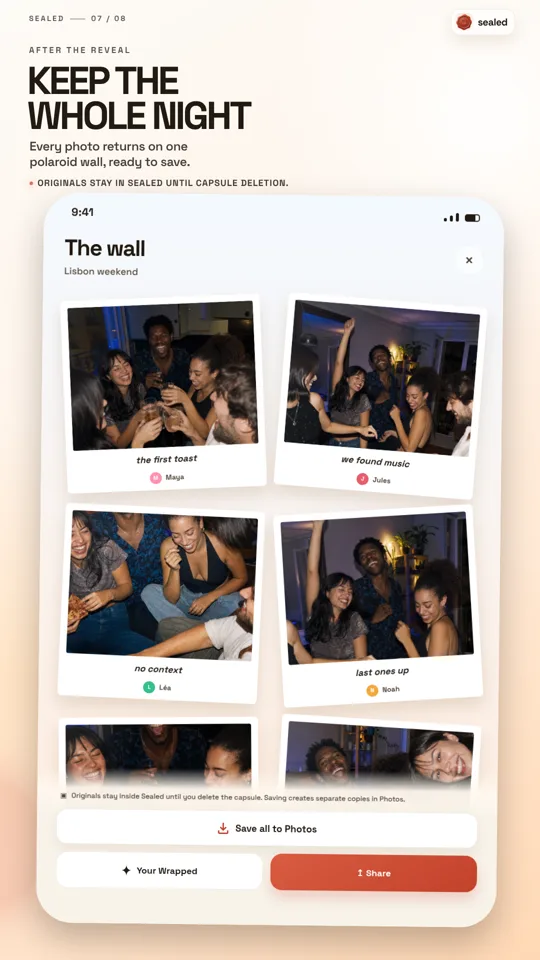
This is the specific angle Sealed occupies: it's built around delayed, shared reveal rather than instant posting, on the idea that a group opening photos together afterward creates a different kind of moment than a scattering of individual live posts. It's a group photo capsule concept - everyone shoots, nobody peeks, and the group opens it together - rather than a live-sharing tool, so it fits couples who specifically want to avoid the live-preview pressure, not those who want real-time galleries during the event.
Because this is a public product context rather than a tested outcome, the fair way to frame it is as a design choice for couples who value anticipation and a shared moment over immediate documentation. Whether that fits a given wedding depends on the couple's priorities, not on any claimed performance advantage.
A worked example: a 90-guest wedding without an app requirement
Example (hypothetical, for illustration only): A couple planning a 90-guest wedding wants guest photos but doesn't want to require an app download. They print small cards for each table with a short note: 'Take photos freely - please check with people before sharing anything identifiable beyond our group, and send us your favorites within a week using the link below.' The link goes to a simple upload page, no login required.
In this example, the couple also decides they don't want to see photos trickle in individually - they'd rather experience them together with close family a week or two after the wedding. So they set an informal date for a 'reveal evening,' collecting everything before that date rather than looking at submissions as they arrive.
This illustrates the two separable decisions from earlier in this article: a low-friction, no-app collection method, and a deliberate choice about when the group actually looks at the results together. Neither decision requires a specific product; a couple could build this manually with a shared drive and a shared calendar, or choose a tool designed around delayed group reveal if that ritual matters to them.
A short decision checklist
Before settling on a wedding photo sharing without app approach, it helps to answer a few concrete questions rather than defaulting to whatever seems easiest at the time.
This checklist is meant as a starting point, not a complete policy - couples should adapt it to their guest list size, venue rules and comfort with technology.
- Do guests need to log in or create an account, or can they upload with one tap?
- Who is responsible for asking about consent before photos of identifiable people leave the private group?
- Will photos be viewed as they arrive, or gathered and revealed together at a set time?
- Is there a plan for photos involving children or guests who prefer not to be photographed?
- Does the current store listing or app description (if any tool is used) actually match what's promised in your language and region - this is worth checking directly rather than assuming?
Frequently asked questions
Can you share wedding photos with guests without requiring anyone to install an app?
Yes. Options include a shared cloud folder, an email or text-based collection method, or a simple no-login upload page linked from a printed card. Each trades off ease of use against organization, so it's worth matching the method to guest comfort with technology and the size of the wedding.
Who needs to consent before wedding photos are shared more widely?
Anyone identifiable in a photo has a reasonable interest in how it's shared, especially beyond the immediate group who attended the event. This matters most for children and for any use beyond private sharing, such as social posts or public galleries, where consent should be more deliberate than simply assuming it's fine.
Is it better to share wedding photos live or wait and reveal them together later?
There's no universal answer, but the two approaches produce different experiences: live sharing surfaces fragments in real time, while a delayed, shared reveal creates a single collective moment afterward. Couples who value anticipation over immediate documentation may prefer a delayed-reveal approach, while others may want photos visible as the day unfolds.
Sources and further reading
These resources provide the wider reference frame. Product statements on this page are limited to the public information provided by Sealed.