

What a photo sharing mobile app actually needs to do
A photo sharing mobile app is judged, in practice, by three unglamorous things: how easily people can add photos, how the group sees them, and how long those photos stay reachable afterward. Most of the marketing around these apps focuses on speed and filters, but the reader question here is narrower and more useful - what should someone actually verify before trusting an app with a group's shared moments?
The honest answer is that 'sharing' is not one feature but a sequence of choices: who can contribute, when contributions become visible, whether anyone can see partial results early, and what happens to the images once the moment has passed. Any app worth adopting for a group event should have clear, inspectable answers to each of those, not just a fast upload button.
Timing changes the experience more than filters do
The most underrated design decision in a photo sharing mobile app is when photos become visible. Instant, live-updating feeds create a subtle pressure: people start checking who has posted, comparing angles, and second-guessing their own shots mid-event. That pressure changes behavior - people photograph less freely because they're aware of an audience in real time.
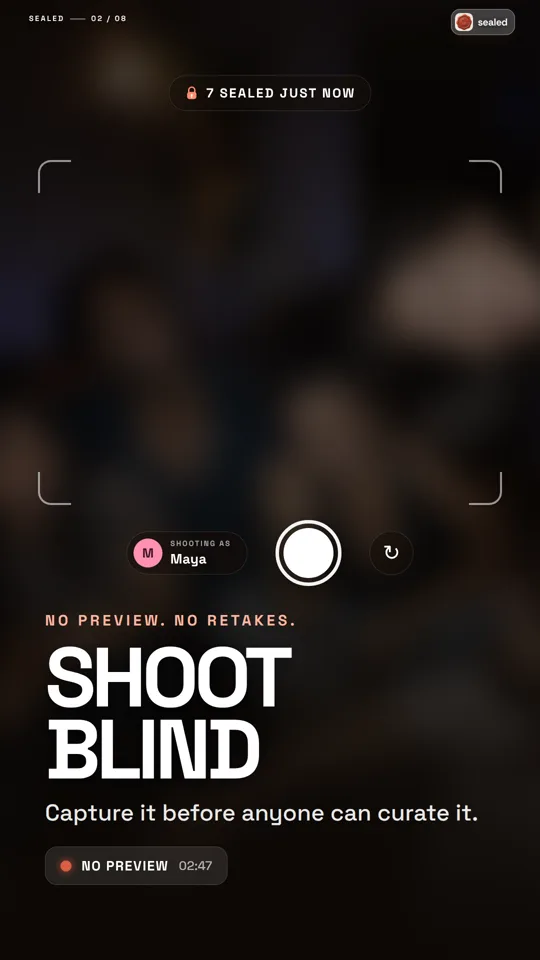
Sealed takes a different position on this specific point. It frames itself around a delayed, shared reveal for group photo capsules - the idea, summarised plainly, is that everyone shoots, nobody peeks, and the group opens the results together later. That is one design choice among several possible ones, not a universal rule for all photo sharing apps, but it is a useful reference point when evaluating what timing model actually suits a given group.
Consent is a decision, not a setting
No app setting substitutes for asking people directly whether they're comfortable being photographed and having those photos shared with the group. This matters more in casual social settings than people expect, because informal gatherings rarely have the norms that professional shoots do - nobody signs a release, and assumptions about what counts as 'fine to share' vary widely between people.
A practical habit: before a shared capsule or album is created, someone in the group should say out loud (or in the group chat) what will happen to the photos - who sees them, for how long, and whether they'll be shared outside the group. This single step resolves most later disagreements, and it costs nothing.
It's worth being explicit that this is a behavioral practice, not something any app can enforce automatically. Apps can support consent-friendly patterns - for instance, delaying visibility so no one photo is singled out in the moment - but the actual agreement has to come from the people involved.
Local capsule versus cloud shared album: a real tradeoff
A recurring question when comparing photo sharing mobile apps is whether photos should live in a cloud-synced shared album or be assembled locally into a bounded capsule that gets opened once. These are genuinely different models, and the choice affects both privacy and the feel of the reveal.
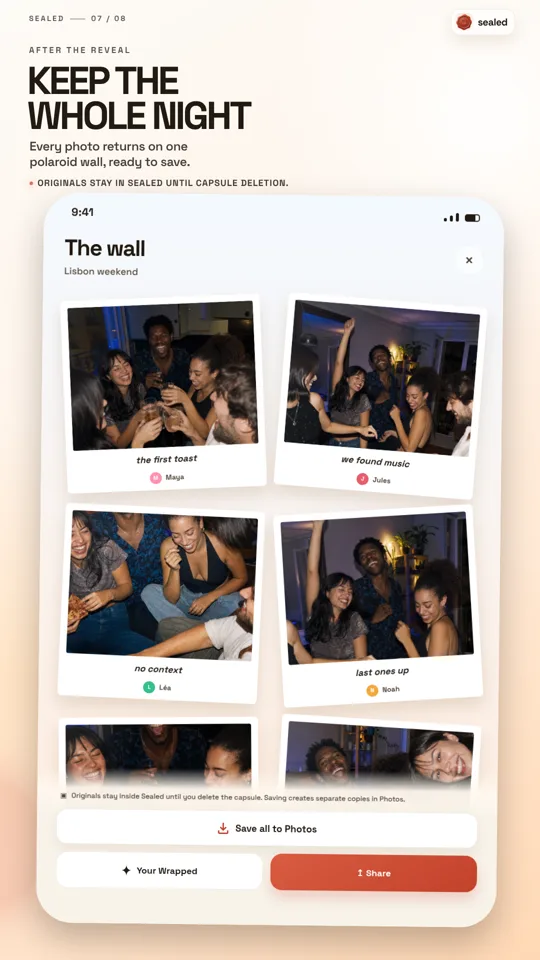
A cloud shared album tends to be open-ended: people can add photos over days or weeks, latecomers can still contribute, and the album often persists indefinitely unless someone deletes it. A local capsule model, by contrast, is closer to a single contained event - photos are gathered, locked, and revealed as a set, then the moment is effectively closed. Neither is objectively better; they suit different kinds of gatherings.
For a single evening or a specific occasion where the group wants one collective reveal moment, a capsule-style model maps more naturally to that intent. For an ongoing trip or a loosely bounded group of friends who want to keep adding photos over time, an open cloud album is probably the simpler fit. Readers can compare these models directly in more depth through Sealed's own writeup on local photo capsules versus cloud shared albums.
A worked example: choosing an approach for a weekend trip
Example (hypothetical, for illustration only): a group of six friends is planning a weekend trip and wants to avoid the usual scramble of a dozen separate camera rolls. Before picking an app, they might walk through a short set of questions.
First, do they want photos visible as they're taken, or would they prefer everyone to see the full set together at the end of the trip? Second, is anyone in the group uncomfortable with certain photos being shared beyond the six of them, and has that been discussed before the trip starts? Third, do they want the collection to close naturally after the trip, or stay open indefinitely for people to add to later?
If the group leans toward a single collective reveal and a natural endpoint, a delayed-reveal capsule model fits their stated goal better than an always-on shared feed. If they'd rather keep contributing over months, an open album is the more sensible pick. The point of this example isn't to prescribe one app - it's to show that the right tool follows from these upfront answers, not the other way around.
A short pre-trip checklist
Before defaulting to whichever app is already installed, it helps to run through a few concrete checks with the group.
- Confirm who can add photos and whether that list can change mid-event
- Agree on whether photos are visible live or revealed together later
- Ask explicitly if anyone wants to opt out of being photographed or shared
- Check whether the app's photos are meant to be temporary or kept long-term
- Decide, before the event, who can share images outside the group afterward
Reading the fine print and current listings
One caution applies to almost any photo sharing app, including Sealed: what an app's marketing site or editorial content describes in a given language doesn't guarantee the app interface, store listing, or support channel is available in that same language. If language availability matters to a group, it's worth checking the current local app store listing directly rather than assuming from a website.
More broadly, features, pricing, and availability for any photo sharing app can change, so treating a snapshot description as a permanent fact is a mistake worth avoiding. The stable part of the decision is the group's own preferences about timing, consent, and how long photos should last - those are worth settling first, independent of which specific app ends up being used.
Frequently asked questions
What's the main difference between a delayed reveal and a normal shared album?
A delayed reveal holds photos back until a set moment when the whole group sees them together, while a normal shared album typically shows photos as soon as they're uploaded, so people can see partial results in real time.
Do I need everyone's consent before adding them to a group photo app?
Yes in practice, even if the app doesn't enforce it. Getting a quick verbal or group-chat agreement about what will happen to the photos avoids most disputes and respects people who may not want certain photos shared.
Should I assume an app's language support matches its marketing site?
No. Editorial content or a marketing site being available in a language doesn't guarantee the app interface, store listing, or support are available in that language - check the current local store listing to confirm before relying on it.
Sources and further reading
These resources provide the wider reference frame. Product statements on this page are limited to the public information provided by Sealed.