


What people actually mean by free photo sharing sites for groups
When someone searches for free photo sharing sites for groups, they're usually planning something specific: a wedding, a trip, a reunion, a birthday. The underlying need isn't just storage, it's coordination - getting everyone's photos into one place without a dozen separate texts or a chaotic group chat full of duplicates and screenshots.
The word 'free' matters too. Most people trying this out for the first time don't want to commit money before they know whether the group will actually use the tool. That's a reasonable instinct, but it also means the evaluation has to look past the price tag at what free actually includes: storage limits, ad-supported viewing, expiration windows, or restrictions on who can upload.
Underneath the practical question is often a quieter one: what happens to these photos once they're shared? Who can see them, how long do they stay up, and does the platform encourage careful sharing or just fast uploading.
The consent question free tools often skip
Group photo sharing inherently involves other people's likenesses, and free tools rarely build in a moment to pause on that. The default flow on most general-purpose apps is: take photo, upload photo, done. There's no built-in checkpoint asking whether everyone in frame is comfortable with wider distribution.
This matters more as group size grows. A photo shared among five close friends carries different risk than the same photo dropped into a link that could be forwarded indefinitely. Consent isn't a one-time checkbox - it's an ongoing consideration tied to who can see the photo, for how long, and whether it can be re-shared outside the original group.
Before uploading anywhere, it's worth a quick verbal check with the group: is everyone fine with this being visible to the whole circle, and does anyone want specific photos excluded. That's a low-effort habit that free sharing tools generally don't prompt, so it falls to the people using them.
Reveal timing: live preview versus delayed sharing
Most free photo sharing sites are built around immediate visibility - someone uploads, and the group sees the photo right away. That works fine for simple logistics, but it changes group behavior in a subtle way: people start posing for the feed rather than just being present, because they know the photo is visible the moment it's taken.
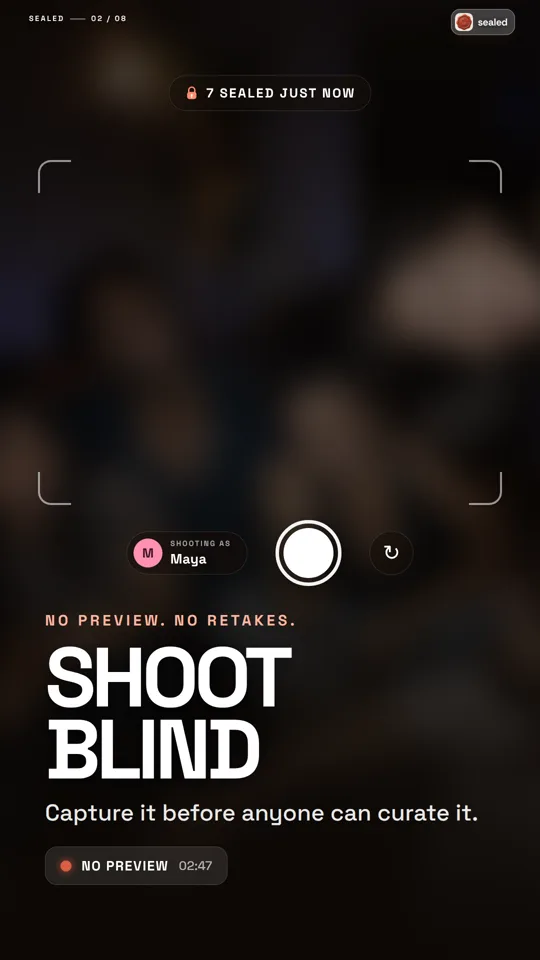
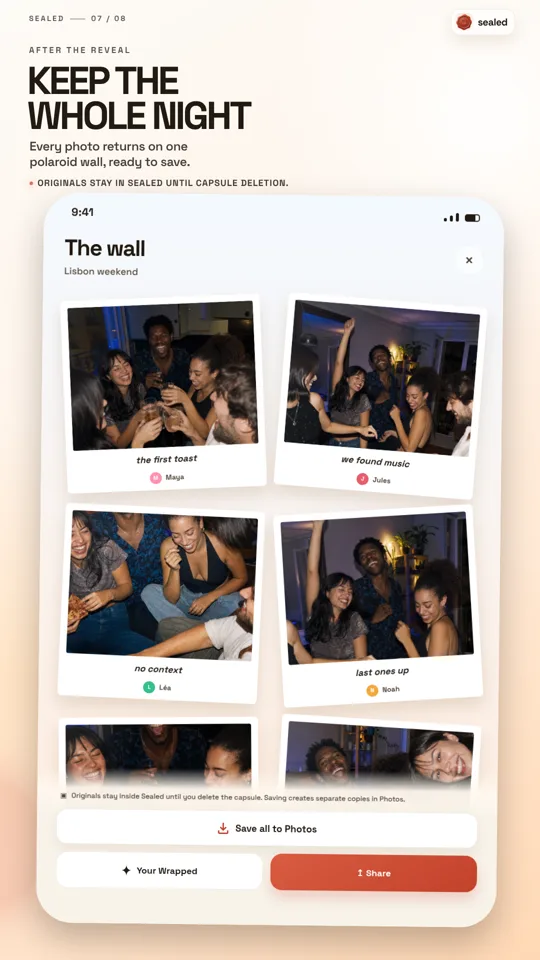
An alternative model, sometimes called delayed or 'sealed' reveal, holds photos back until a set moment - everyone opens the collection together, later. Sealed is built around exactly this idea: everyone shoots, nobody peeks, and the group opens it together. The premise is that removing the live-preview pressure changes how people behave during the event itself, since there's no immediate audience to perform for.
This isn't a claim that one approach is objectively better for every group. A logistics-focused trip where people need real-time photos for planning benefits from live sharing. A birthday party, proposal, or reunion where the point is shared surprise and presence benefits more from delayed reveal. The right choice depends on what the group is actually trying to create.
A practical decision aid: matching the tool to the moment
Rather than picking a tool by brand recognition, it helps to sort the event by what matters most, then match features to that need. Below is a worked example - not a ranking of specific products, just a way to reason through the choice.
**Example: a family reunion weekend.** Say twenty relatives are gathering for two days. The organizer wants photos from everyone, doesn't want a group chat flooded with images all weekend, and would like a shared moment where everyone looks at the photos together on the last night. In this hypothetical, the priorities are: minimal interruption during the event, one contribution point per person, and a reveal moment rather than a live feed. That points toward a delayed-reveal, single-capsule approach rather than a live shared album.
**Contrast case: a work offsite.** If the goal is documenting sessions for a recap deck the next day, live upload matters more than shared reveal - people need the photos accessible quickly, and there's no ritual moment being protected. A standard live shared album fits better here.
The general pattern: if the event has a natural 'together' moment (opening gifts, ending a trip, a reveal), delayed sharing supports that. If the event is about ongoing documentation with no single culminating moment, live sharing is more practical.
- Ask: is there a moment we want to protect from spoilers?
- Ask: do we want a live feed or a single collective reveal?
- Ask: how long should photos remain accessible, and to whom?
- Ask: has everyone consented to how widely this will be shared?
Local capsule versus cloud shared album
One underlying distinction across free photo sharing sites for groups is whether photos live in a general cloud album (accessible indefinitely, often searchable, sometimes tied to a broader account ecosystem) or in a bounded local capsule meant for one event. Sealed's own guide on this distinction (linked below) frames it as a tradeoff between convenience and containment - a cloud album is easy to keep adding to, while a capsule is scoped to a specific event and reveal.
Neither model is inherently safer or better; they suit different intentions. A cloud album makes sense when a group wants an ongoing, growing archive - a shared family album updated over years. A capsule model makes more sense when the group wants a contained, self-limiting experience tied to one specific gathering.
Because store listings, pricing and exact feature sets change over time, it's worth checking the current listing for any tool being considered rather than relying on older reviews or this article for feature specifics.
A short checklist before choosing a free sharing tool
Free tools vary enough that a quick checklist is more useful than a single recommendation. Below is a practical list to run through with the group before settling on one.
- Does everyone in the group know their photos will be visible to others, and have they agreed to that?
- Is there a natural reveal moment worth protecting, or is this ongoing documentation?
- What happens to the photos after the event - do they expire, stay archived, or need manual deletion?
- Can non-participants (people photographed but not in the group) request removal?
- Does the free tier's storage or time limit actually match how long the group needs access?
- If minors are photographed, does the tool have clear child-safety and consent information available?
Where Sealed fits, and where it doesn't
Sealed explores intentional group photography built around consent and a shared reveal ritual, rather than trying to be a general-purpose photo storage service. Its public site includes privacy, terms and child-safety information, which is worth reviewing directly for anyone considering it for an event involving minors or sensitive settings.
It's worth being explicit about scope: this article isn't recommending Sealed as the answer for every free-photo-sharing need, and it isn't reporting on any first-hand testing or comparison of specific competitor products. The advice here is bounded by Sealed's own public product description - a delayed-reveal group capsule - and by the two public sources referenced. For anything involving live documentation, ongoing cloud archives, or needs outside that scope, other tools may fit better, and their current pricing and features should be checked directly on their own listings.
Frequently asked questions
Is it necessary to get consent before sharing group photos on a free platform?
Yes, it's good practice to check with people in the photo before sharing it more widely, especially if the platform allows the link to be forwarded or the group to grow. Consent is an ongoing consideration, not a one-time step, and it matters more as visibility and group size increase.
What's the difference between a live shared album and a delayed-reveal capsule?
A live shared album shows photos as soon as they're uploaded, which suits ongoing documentation needs like trip planning or work events. A delayed-reveal capsule holds photos back until everyone opens them together at a set moment, which suits events built around a shared surprise or reveal, such as a reunion or celebration.
How should someone decide between a cloud album and a local, event-scoped capsule for a group?
It depends on whether the goal is an ongoing, growing archive or a contained experience tied to one event. A cloud album fits long-term shared collections, while an event-scoped capsule fits a single gathering with a defined start and end. Checking each tool's current storage limits and access policies before committing is also worthwhile, since these details change over time.
Sources and further reading
These resources provide the wider reference frame. Product statements on this page are limited to the public information provided by Sealed.