


What people actually mean by a photo album to share
When someone searches for a photo album to share, they're usually describing one of two different needs. The first is a running archive: a place where a group can keep adding photos over months or years, browsable whenever someone wants to look back. The second is a bounded moment: a set of photos from one event or trip that the group experiences together, often for the first time, at a specific point rather than trickling in as people take them.
These two needs pull in different directions. A running archive rewards easy uploading and immediate visibility, so people can see what others have added right away. A bounded moment rewards the opposite: photos collected without anyone previewing them individually, so the group encounters the set together rather than piecemeal. Before picking a tool, it helps to name which of these you actually want, because most of the friction people report with shared albums traces back to using an always-on tool for a moment that was meant to feel collective.
Consent and who gets a say before sharing
Any shared photo album that includes identifiable people carries a basic obligation: those people should have a chance to agree to being photographed and to how the images will be shared, not just discover it after the fact. This matters more in a group photo album to share than in a personal camera roll, because a shared album usually reaches people beyond the person who pressed the shutter - other guests, family members outside the original group, or anyone forwarded a link.
In practice this means thinking about consent at two points: when the photo is taken, and when the album is opened up to a wider circle than the people who were present. A polite norm - asking before photographing someone closely, and checking before re-sharing an album outside the original group - avoids most disputes. It's also worth deciding in advance who can remove a photo they're unhappy with, since that question is much easier to agree on before the album exists than after someone is unhappy with how they look in it.
Local capsule versus cloud shared album
One structural choice shapes almost everything else: does the shared album live in the cloud, updating in real time as people add to it, or does it start as something more contained - photos collected locally and released together - before being shared out. Sealed's own comparison of a local photo capsule against a cloud shared album lays out this distinction in more detail, and it's worth reading if you're unsure which shape fits your group.
Broadly, a cloud album is better suited to an archive that will keep growing: a family photo stream, a long trip with many contributors, a project where new images should appear as soon as they're taken. A local-first capsule suits a single occasion where the appeal is that nobody has seen the photos yet - a party, a reunion, a wedding - and the group wants to open the results together rather than watching them accumulate individually beforehand.
Neither shape is objectively better; they answer different questions. If your reader question is really 'how do I keep a shared album going long-term,' a cloud tool with strong permission controls is the more direct answer. If the question is closer to 'how do I get everyone's photos from one event without anyone previewing them first,' a capsule model is worth exploring instead.
A worked example: choosing for a weekend reunion
Example (hypothetical, not a case study): imagine ten friends spending a weekend together, several of whom will take photos on their own phones throughout. The group wants one shared result at the end rather than a stream of individual posts during the weekend, and a couple of people are camera-shy and want a say before anything is shared further.
Working through the four principles helps clarify the choice. Shared anticipation suggests avoiding a tool that shows uploads as they happen, since that removes the sense of a collective reveal. Participant consent suggests agreeing up front - even informally, in the group chat - that photos won't be forwarded outside the group without asking first. Minimal interruption suggests picking a method that doesn't require people to stop and check a feed mid-weekend. Thoughtful reveal suggests picking a specific moment, like Sunday evening, to look at everything together rather than doing so gradually.
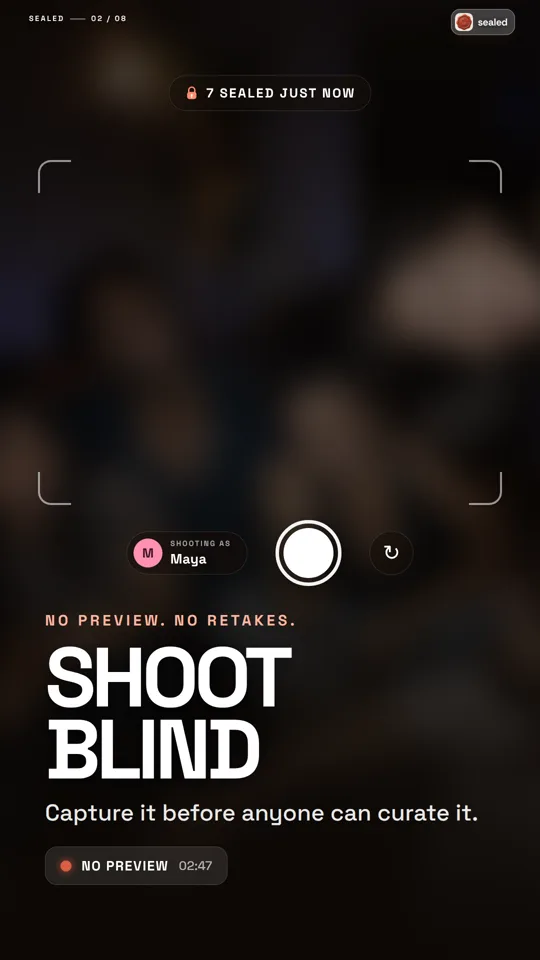
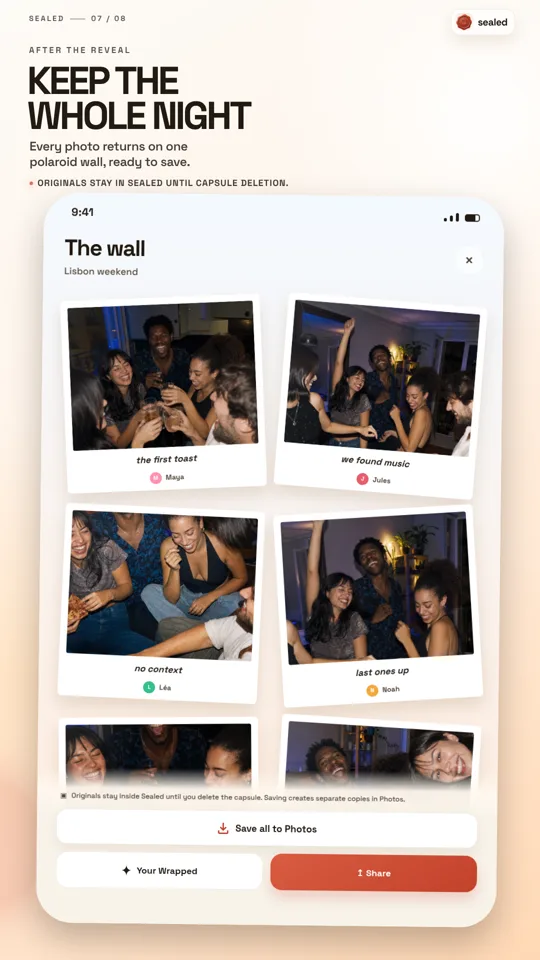
Under this reasoning, a delayed, collectively-opened set of photos fits the brief better than a live-updating stream - which is the situation Sealed's product idea addresses, since it's built as a group photo capsule where everyone shoots, nobody previews individually, and the group opens the result together. That's a narrow, specific fit rather than a universal recommendation; a different group with different goals might reasonably prefer a live cloud album instead.
A short checklist before you commit to a tool
Rather than researching every option, it's usually faster to answer a few concrete questions first and let the answers point you toward archive-style or reveal-style tools.
- Does the group want to see photos as they're taken, or together at one moment?
- Has everyone in the photos agreed to being photographed and to how images will be shared?
- Will this album ever be forwarded or shown to people outside the original group, and who decides that?
- Does anyone in the group need the ability to remove or veto a specific photo?
- Is this a one-off event or an ongoing archive that will keep growing?
Where the language claims stop
It's worth noting a limit that's easy to overlook: an article or guide being written in a given language doesn't guarantee that an app's interface, its store listing or its support channel are available in that same language. If language availability matters for your group, check the current store listing directly rather than assuming from marketing copy.
Similarly, Sealed's public site includes privacy, terms and child-safety information, which is the right place to check specifics - retention, deletion, or how minors' images are handled - rather than relying on a general description here. Those documents change over time and are the authoritative source, not a summary article.
Frequently asked questions
What's the difference between a shared photo album and a photo capsule?
A shared photo album typically updates continuously as people upload, so contributors and viewers can see new photos as soon as they're added. A photo capsule collects photos without individual preview and reveals them to the group together at a chosen moment, prioritizing a collective first look over ongoing visibility.
Do I need everyone's consent before adding them to a shared album?
Yes, as a general practice, anyone identifiable in a photo should have a chance to agree to being photographed and to how the photo will be shared, especially before the album is shown to people outside the original group. This is a courtesy and often a legal consideration depending on where you live, so when in doubt, ask first.
Is a cloud shared album or a local capsule better for a one-time event?
For a single event where the group wants to experience the photos together for the first time, a local-first capsule model - where photos aren't previewed individually before a shared reveal - tends to fit better than a continuously updating cloud album. For an ongoing archive that will keep growing over time, a cloud album with clear permission settings is usually more practical.
Sources and further reading
These resources provide the wider reference frame. Product statements on this page are limited to the public information provided by Sealed.