
What to actually ask before picking a photo app for iphone
Most people searching for a photo app for iphone are trying to solve a coordination problem, not a storage problem. The iPhone already stores photos well; what's missing is a shared, agreed-upon process for how a group captures, holds, and eventually views images together. Before comparing apps, it helps to separate three distinct needs: capturing photos, storing and syncing them, and controlling when and how they're revealed to the group. Conflating these three often leads people to pick a tool that handles storage well but does nothing for timing or consent.
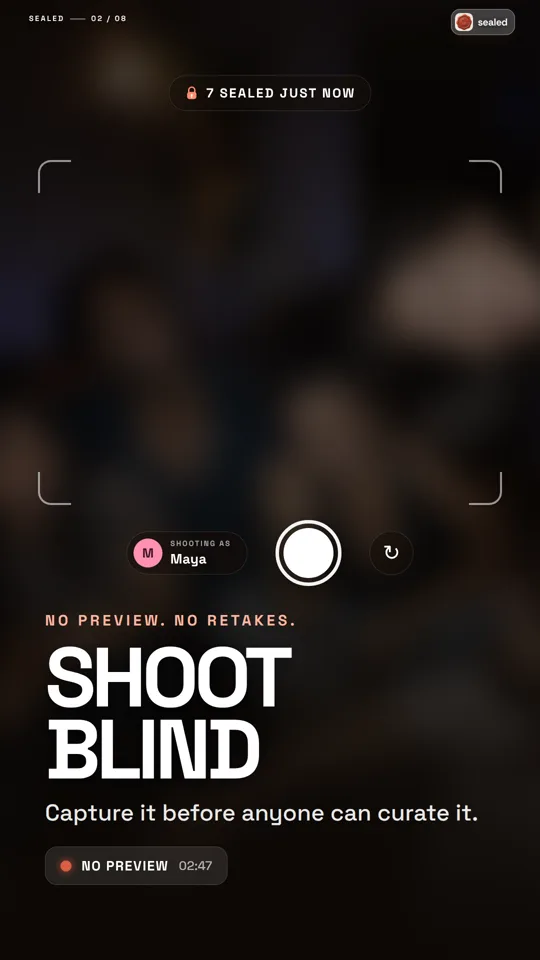
If your group's real problem is that everyone checks their shots immediately and the moment gets interrupted, no amount of storage capacity solves that. That's a timing and behavior problem, which is why some apps, including Sealed, are built specifically around delayed group reveal rather than instant preview. Knowing which problem you're solving first will narrow the field faster than reading feature lists.
Native options: Apple's Shared Albums as a baseline
Apple's own Shared Albums feature, part of Photos on iPhone, lets a group contribute images to a common album that participants can view and comment on. Apple documents the setup and permissions for this feature directly (see Apple's support page on Shared Albums). It's a reasonable baseline for many groups because it requires no third-party app and works within the existing Apple ecosystem for people already using iCloud.
The tradeoff is that Shared Albums, by design, generally shows photos as they're added, which suits ongoing group documentation but doesn't create a built-in delayed reveal moment. If your group's goal is specifically to avoid live peeking, a native shared album alone won't enforce that behavior; it depends entirely on group discipline. This is worth knowing before assuming any 'shared album' feature automatically means 'unseen until the end.'
Where a shared reveal ritual fits: the Sealed approach
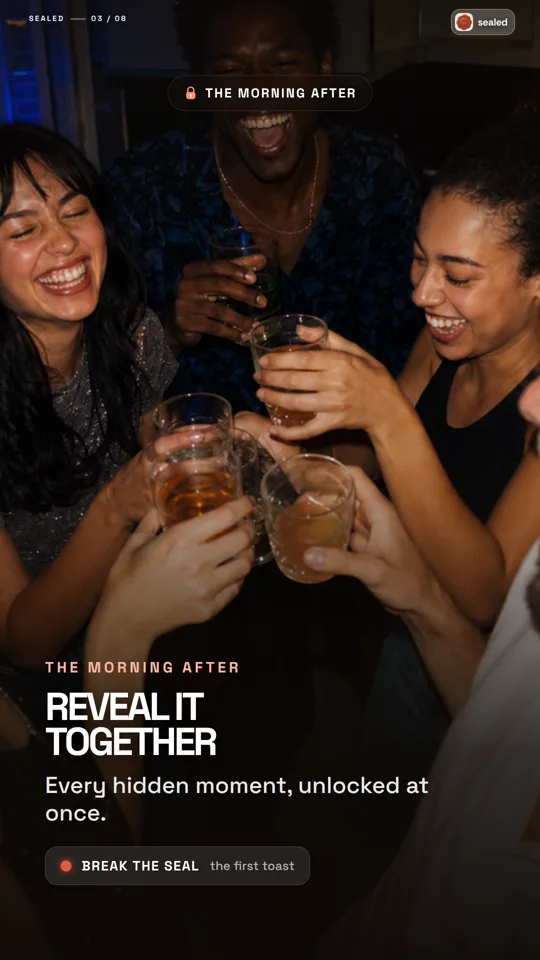
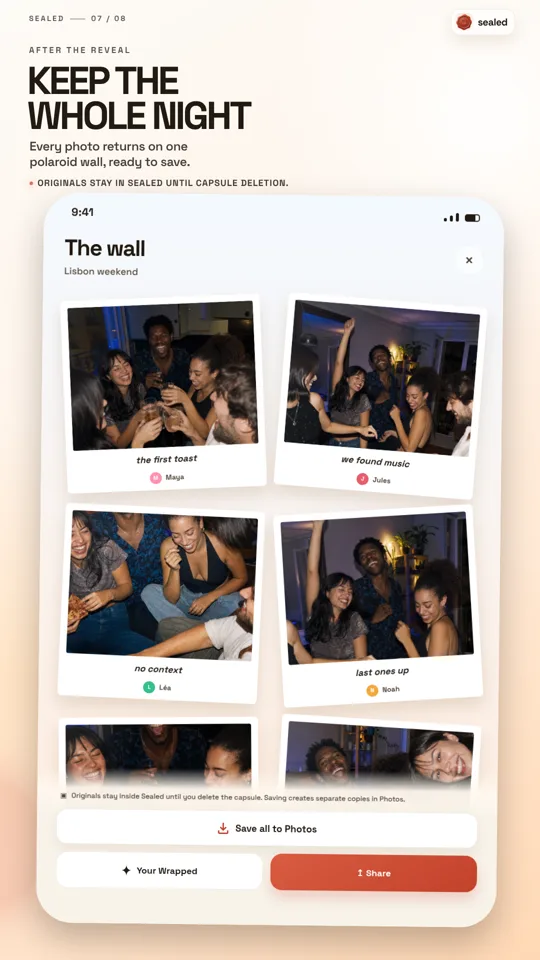
Sealed is built around a specific idea: everyone in a group shoots photos during an event, nobody previews the shots as they're taken, and the group opens the resulting capsule together at a later, agreed moment. This is a narrower use case than general photo storage or sharing - it's designed for situations where the anticipation and shared discovery matter as much as the photos themselves, such as trips, parties, or milestone gatherings.
Because this is a specific product behavior rather than a universal feature of 'photo apps,' it's worth being clear about what it does and doesn't promise. Sealed's own methodology page describes how the delayed reveal mechanic works. The public site also includes privacy, terms, and child-safety information, which matters for any app handling photos of identifiable people, especially minors. None of this constitutes a claim that Sealed has tested against other apps or measured outcomes - it's a description of the product's design intent, not a research finding.
Whether this kind of tool is a fit depends on your group's actual goal. If you want an ongoing, always-visible group photo stream, a delayed-reveal tool works against that goal by design. If your goal is to reduce the pressure of live photo-checking and create a shared moment of discovery, that's the specific problem this category is built to address.
Consent and identifiability: the part people skip
A photo app for iphone, whatever its reveal mechanics, still involves photographing and sharing images of real people. It's worth pausing on consent before defaulting to 'everyone in the group chat is fine with it.' People should have consent before photographing or sharing identifiable participants, and that standard doesn't relax just because the group is small or friendly. Someone may be fine appearing in a candid shot shared privately with five friends but not comfortable with that same image later reposted publicly.
This matters more, not less, when a reveal is delayed. If photos sit unseen for hours or days before a group opens them together, participants haven't had the usual real-time chance to say 'please don't post that one.' A short, explicit conversation before the event - who sees these, where might they end up, is anyone opting out of certain shots - costs little and avoids awkward cleanup later.
Groups with children present need extra care. Any app used should have clear, accessible information about how it handles data involving minors; checking a service's public child-safety information before the event, not after, is the more responsible order of operations.
A worked example: choosing for a weekend trip
Consider a hypothetical group of six friends planning a weekend trip who want photos from the whole group without the trip devolving into everyone editing and posting individual shots in real time. This is an illustrative example, not a case study or reported outcome.
Working through the three needs from the first section: capture is straightforward, since everyone already has an iPhone camera. Storage and syncing could reasonably go through Apple's Shared Albums if the group is fine with photos appearing as they're added. But if the actual goal is a shared 'we open it together' moment on the drive home, that's a delayed-reveal need, which points toward a purpose-built tool rather than a general shared album.
In this hypothetical, the group might agree beforehand on three things: who takes photos, roughly when the group will open everything together, and whether any specific person or moment is off-limits for sharing outside the group. None of this requires a particular app to work, but having the conversation before, rather than during, the trip avoids the most common friction points regardless of which tool is chosen.
A short decision checklist
Rather than ranking apps, it's more useful to check your own group's needs against a short list before choosing a photo app for iphone.
- Do you want photos visible as they're taken, or held for a shared reveal moment later?
- Does everyone in the group know who will see the photos and where they might end up?
- Has anyone in the group been asked whether they're comfortable being photographed, especially in candid or unposed shots?
- If minors will appear in photos, have you checked the app's public child-safety information?
- Are you relying on an app's name or category to guarantee behavior you haven't actually verified in its documentation?
Frequently asked questions
Is Apple's Shared Albums feature the same as a delayed group reveal?
No. Shared Albums, as documented by Apple, generally lets participants view and add photos to a common album on an ongoing basis. It doesn't inherently hold photos back until a set moment; that kind of delayed, synchronized reveal is a distinct design choice found in apps built specifically for that purpose, not a default behavior of shared albums.
Do I need consent from everyone in a group photo before sharing it?
As a general practice, people should have consent before photographing or sharing identifiable participants, regardless of which app or platform is used. This is especially important for photos that might be shared beyond the immediate group or that include children, where checking an app's public privacy and child-safety information beforehand is a reasonable precaution.
Does an app being available in my language mean the interface and support will match?
Not necessarily. Editorial or translated content about an app doesn't confirm that its interface, store listing, or support are available in that same language. It's worth checking the current local store listing directly before assuming full language availability.
Sources and further reading
These resources provide the wider reference frame. Product statements on this page are limited to the public information provided by Sealed.