


Why 'photo app for free' is a harder question than it looks
Searching for a photo app for free usually starts with a simple assumption: free means no cost and no trade-offs. In practice, free tiers differ enormously in what they store, how long they keep it, who can see it, and what happens once a group's photos are uploaded. The word 'free' describes a price point, not a feature set or a privacy posture, so the more useful question is what you actually need the app to do before you compare what each option gives away for nothing.
For a group photo ritual specifically, the relevant variables are usually storage location, sharing controls, and whether everyone in the group can see photos as they're taken or only after some agreed moment. These are product decisions that vary by app and by version, so this article won't claim any particular free app is best. Instead it lays out the questions worth asking and a simple way to test candidates against your own group's needs.
What 'free' typically trades away
Free photo apps generally make money or sustain themselves in one of a few ways: advertising, data use for other products, storage limits that push you toward a paid tier, or a genuinely free core feature funded by a separate paid feature. None of these are inherently bad, but each has a different effect on a shared group experience. Storage caps might mean older photos get compressed or deleted. Ad-supported apps might interrupt the viewing experience at exactly the moment your group wants to look through photos together.
It's also worth distinguishing between apps that store photos locally on a device versus those built around a cloud shared album. A local capsule keeps photos on-device until a deliberate export or reveal step, while a cloud album typically uploads photos automatically to a shared, always-accessible space. Sealed's own comparison of these two models frames the trade-off around control and timing rather than price, and that framing is useful even for readers evaluating apps with no connection to Sealed.
- Ask what happens to photos after a storage limit is hit
- Check whether viewing is ad-supported or interruption-free
- Confirm whether the free tier is local storage, cloud storage, or a mix
Consent and free apps: an easy thing to overlook
When an app is free, groups often download it quickly and start shooting without pausing to discuss expectations. That's exactly when consent gets skipped. Anyone appearing in photos should have agreed, at least informally, to being photographed and to how those photos might be shared afterward - with the group, publicly, or not at all. This matters regardless of price; a free app carries the same consent obligations as a paid one.
A practical habit is to say out loud, before shooting starts, what the group intends to do with the photos: keep them private to the group, post some publicly, or decide later. This single sentence at the start of an event resolves most later disagreements and costs nothing, which makes it a natural fit alongside any free tool.
A worked example: choosing between three free options
Here is an illustrative, hypothetical scenario to make the trade-offs concrete. Imagine a group of eight friends planning a weekend trip who want to use a free photo app so everyone can contribute photos without anyone editing the group's memory in real time by posting selfies mid-event.
Option A is a free cloud album that uploads photos instantly and lets anyone view them as they arrive. This suits groups who want live sharing but works against a group that specifically wants to avoid seeing photos until later, since anticipation is lost the moment the first photo lands. Option B is a free app with a delayed reveal mechanism, where photos are collected but not visible to the group until a set time or trigger. This suits the trip scenario better if the group values a shared 'opening' moment, though it depends on the app's specific delay and consent controls, which should be checked directly rather than assumed. Option C is a free local-only app with manual export, which maximizes privacy and control but requires someone to manage the export and sharing step manually, adding friction for a casual weekend group.
This is a hypothetical illustration, not a review of named products or a claim about their current pricing or features. It's meant to show that the right free app depends on whether your group values live sharing, delayed group reveal, or maximum manual control - not on which app has the biggest storage limit.
How Sealed fits into this question, and its limits
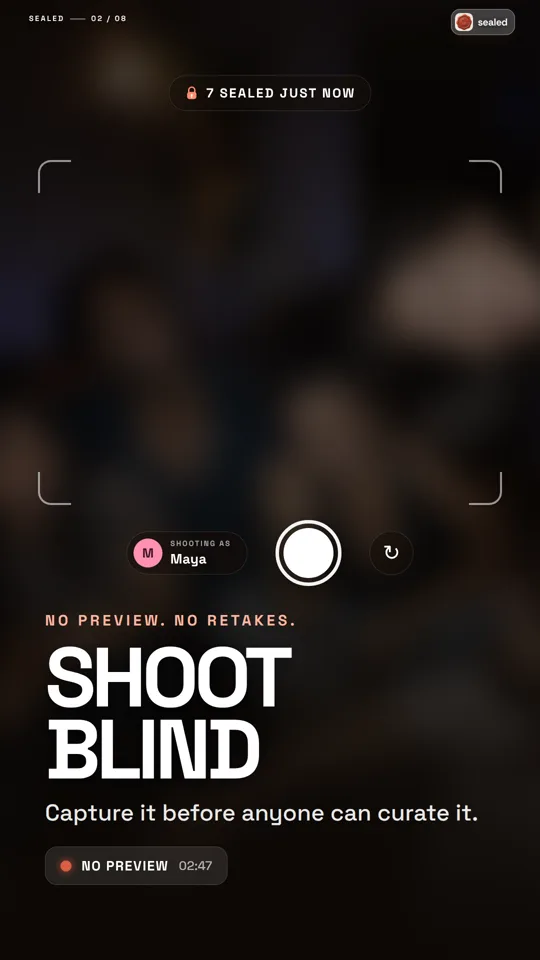
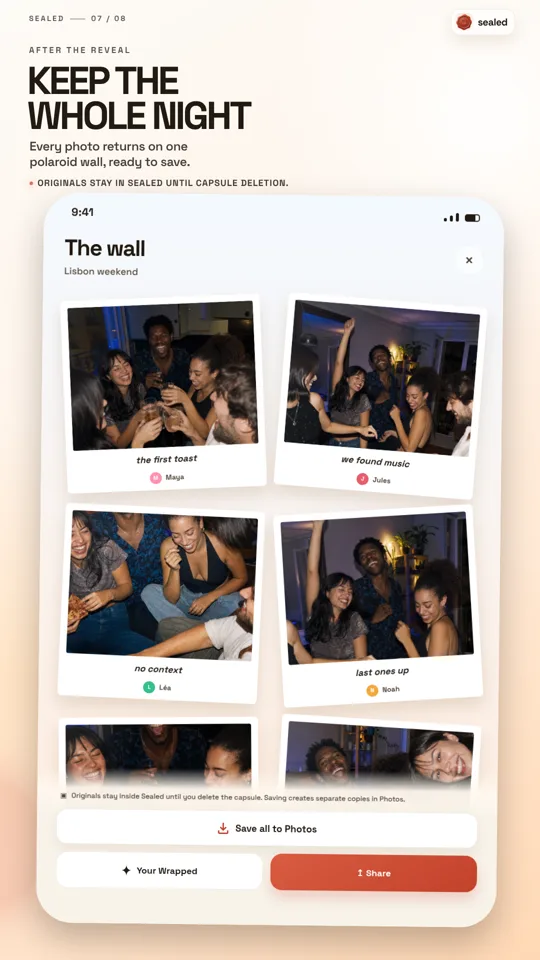
Sealed is a group photo capsule built around delayed, shared reveal: everyone shoots, nobody peeks, and the group opens the results together. It's one way of answering the 'photo app for free' question for groups whose priority is a shared reveal moment rather than live posting, though its cost, availability, and exact feature set can change and should be checked on the current store listing rather than assumed from this article.
Editorial coverage like this piece does not establish that Sealed's interface, store listing, or support is available in every reader's language, and it doesn't substitute for reading Sealed's own privacy, terms, and child-safety pages, which exist on its public site for anyone evaluating whether it fits their group's needs. The advice above about consent and reveal timing applies whether or not a reader ends up choosing Sealed.
A short checklist before you install anything
Before settling on any photo app for free, it helps to run through a short checklist rather than relying on an app store rating alone. Ratings reflect average experience, not your specific group's priorities around privacy, timing, or interruption.
This checklist is meant as a starting point for your own evaluation, not a guarantee that any given app will behave a certain way - features and policies change, so always confirm current behavior in the app itself.
- Does everyone in the group know and agree to being photographed?
- Is photo visibility live, delayed, or manually controlled?
- Where are photos stored, and for how long, under the free tier?
- Is there an ad or upsell interruption during the group viewing moment?
- Can photos be exported or deleted easily if someone changes their mind?
Frequently asked questions
Is a free photo app automatically less private than a paid one?
Not automatically. Privacy depends on how an app stores and shares photos, not on price. A free app with local storage and manual export can be more private than a paid app that automatically syncs everything to a cloud album. Check the specific storage and sharing behavior rather than assuming price predicts privacy.
What should a group agree on before using any photo app together?
At minimum, agree on consent (everyone photographed is comfortable with it), sharing scope (who sees the photos and where), and timing (whether photos appear live or are revealed later as a group). Saying this out loud before shooting starts avoids most disagreements afterward, regardless of which app you use.
Does Sealed being free or paid affect whether it's available in my language or region?
Editorial descriptions of Sealed's product idea don't confirm current interface language, regional availability, or pricing, since these can change. Readers should check Sealed's current public store listing directly to confirm what's available where they are before deciding.
Sources and further reading
These resources provide the wider reference frame. Product statements on this page are limited to the public information provided by Sealed.