

Why 'wedding photo app free' is the wrong first filter
Searching for a wedding photo app free of charge is a reasonable starting point, but price alone tells you almost nothing about whether an app will actually work for a wedding day. The real question is what happens to the photos once dozens of guests start uploading them: who can see them, when, and in what order. A free tier that quietly assumes a live, always-visible photo stream creates a very different guest experience than one built around a delayed or shared reveal.
Before comparing cost, it helps to decide what kind of experience you actually want. Some couples want a live scrolling feed they can watch update during the reception. Others want something calmer: everyone contributes without watching a feed fill up in real time, and the collection is opened together later, more like unwrapping a shared memory than monitoring a livestream. Neither approach is objectively better, but they lead to very different app choices, and 'free' doesn't distinguish between them.
The consent question free apps rarely surface
Any tool that lets a group of guests photograph and upload images of other guests raises a basic consent issue: not everyone at a wedding necessarily wants their photo taken, shared instantly, or shared at all. This is easy to overlook when evaluating an app purely on price and feature list, because consent isn't a line item in a comparison chart.
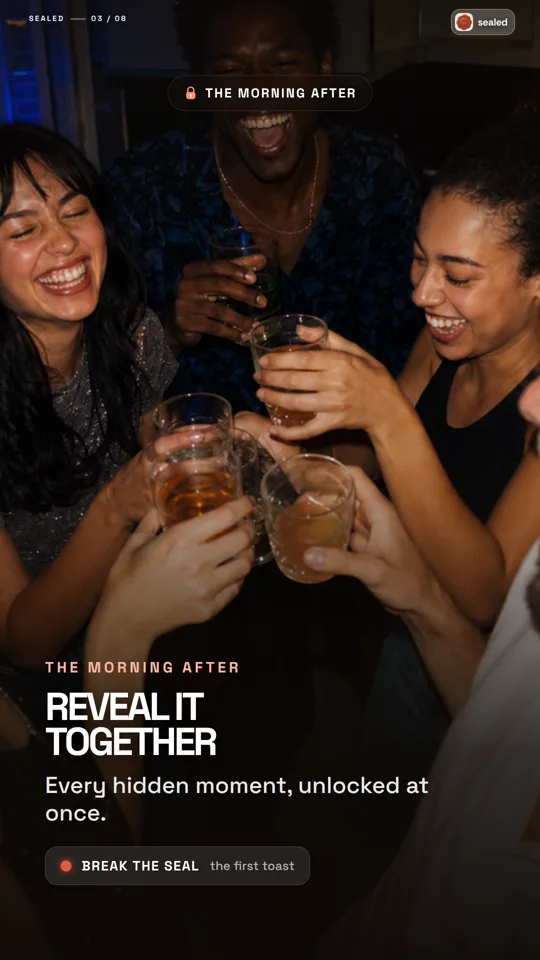
In practice, this means asking, before the event, whether the app or the couple's own guidance gives people a reasonable way to opt out or to be asked before an identifiable photo of them circulates. Sealed, a group photo capsule built around a delayed, shared reveal, treats this as a starting assumption rather than an add-on: the idea is that everyone shoots, nobody peeks, and the group opens the collection together, which naturally slows down the moment between a photo being taken and it being widely seen. That pause doesn't replace asking permission, but it does reduce the chance of a photo being shared impulsively before anyone has had a chance to object.
A practical checklist for evaluating any free wedding photo app
Rather than relying on marketing copy, it's more useful to walk through a short set of concrete questions with whichever app you're considering, free or paid. These questions apply regardless of which tool a couple ultimately picks.
Worked example: imagine a couple, Priya and Tom, comparing three apps for their wedding. They ask each one: Does uploading a photo make it visible to other guests immediately, or is there a delay? Can a guest remove their own photo if they change their mind? Is there any indication of who can see the collection after the wedding, and for how long? Does the app's public site include basic privacy, terms, and information about how minors' images are handled? Running through this exercise, even informally, surfaces more useful differences than a feature-by-feature price comparison would.
- Does the free tier include a live feed, a delayed reveal, or both, and can that be changed?
- Can any guest remove or flag their own photo after uploading it?
- Is there a stated retention or deletion timeline for photos after the event?
- Does the app's public site cover privacy, terms and child-safety information clearly?
- Is there a simple way to tell participants, in advance, how photos will be shared?
Shared reveal as one option among several
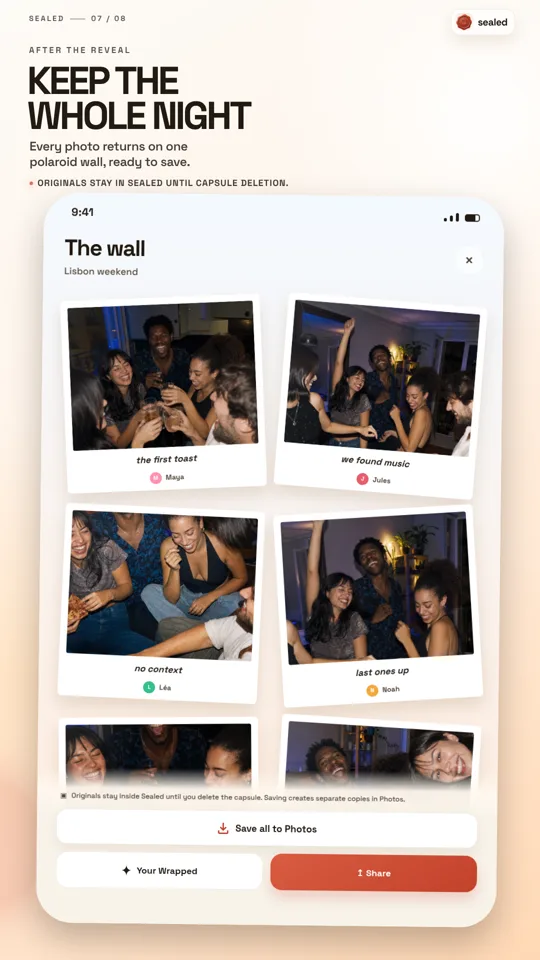
A delayed or shared reveal isn't the only reasonable model for wedding photos, but it's worth understanding as an alternative to a live feed. The underlying idea is that anticipation and a joint 'opening' moment can be part of the experience itself, rather than something to route around. This matters most for larger weddings, where a live feed can become a stream of near-duplicate photos scrolling past in real time, and less critical for very small gatherings where everyone is already looking at the same handful of shots together.
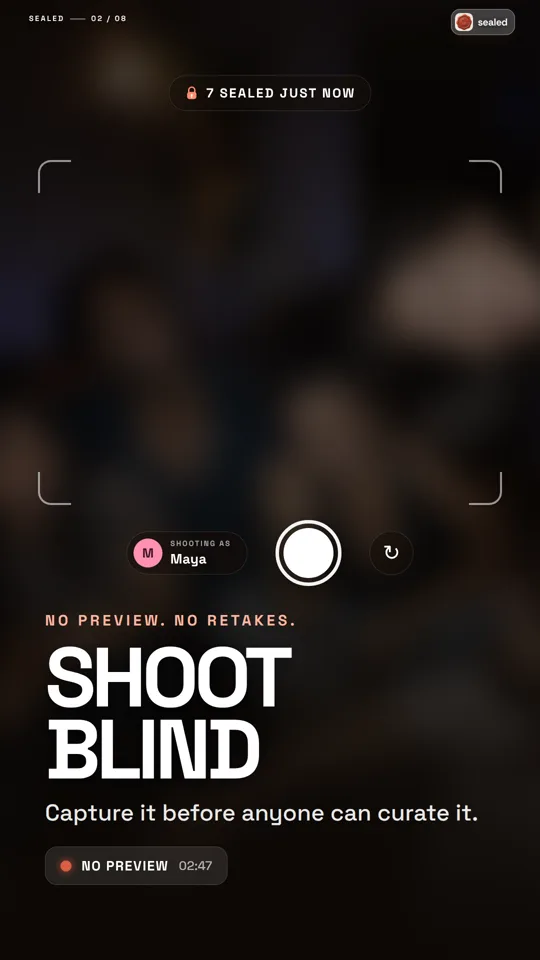
Sealed's own public guidance for wedding guests describes this approach at a practical level: contributors add photos throughout the event without a running preview, and the group experiences the collection together at a later point, such as after the wedding. This is a design choice bounded by what Sealed's public site states about itself, not a claim about how every free wedding app on the market works, and it won't suit every couple's preferences.
What 'free' typically leaves out, and why it matters
Free tiers on any photo-sharing product tend to have limits, whether on the number of photos, the length of time a collection stays accessible, storage resolution, or the number of contributors. Because these limits change over time and vary by provider, this article won't state specific figures as if they were fixed; anyone comparing options should check the current terms directly with the app in question rather than relying on secondhand summaries, including this one.
What's more durable than any specific limit is the underlying question of control: once the wedding is over, who decides how long the photos stay available, whether they can be downloaded, and whether the collection can be deleted entirely if someone requests it. A free app that is vague about deletion and retention is a bigger practical risk than one that simply caps the guest count.
Minimal interruption as a design goal, not a guarantee
One recurring theme worth applying to any wedding photo app, free or otherwise, is minimal interruption: does using the app pull guests out of the moment, or does it fit around what they're already doing? Apps that require frequent check-ins, notifications, or public commentary during the event can work against the atmosphere a couple is trying to create.
This is a design goal, not something that can be verified without using the app yourself at scale, so it's reasonable to test any candidate app with a small group beforehand, such as a rehearsal dinner or engagement gathering, rather than trusting it for the first time on the wedding day itself.
Frequently asked questions
Is a free wedding photo app safe to use for guest photos?
Safety depends less on price and more on specifics: check whether the app's public site explains privacy, data retention, and how photos of minors are handled, and confirm guests have some way to opt out or remove their own uploads before relying on it for a wedding.
What's the difference between a live photo feed and a delayed reveal app?
A live feed shows uploaded photos to the group as soon as they're posted, while a delayed or shared reveal app, such as Sealed, holds photos back until a later moment when everyone views the collection together; the choice affects both atmosphere and how much time exists to address consent concerns before photos circulate widely.
Do I need guest consent to share their photos through a wedding app?
As a general practice, people should have consent before photographing or sharing identifiable participants, so it's reasonable to let guests know in advance how photos will be used and to give them a straightforward way to ask that a specific photo not be shared; this is a courtesy and privacy practice, not legal advice, and specific legal obligations vary by location.
Sources and further reading
These resources provide the wider reference frame. Product statements on this page are limited to the public information provided by Sealed.