What a disposable camera app with QR code actually is
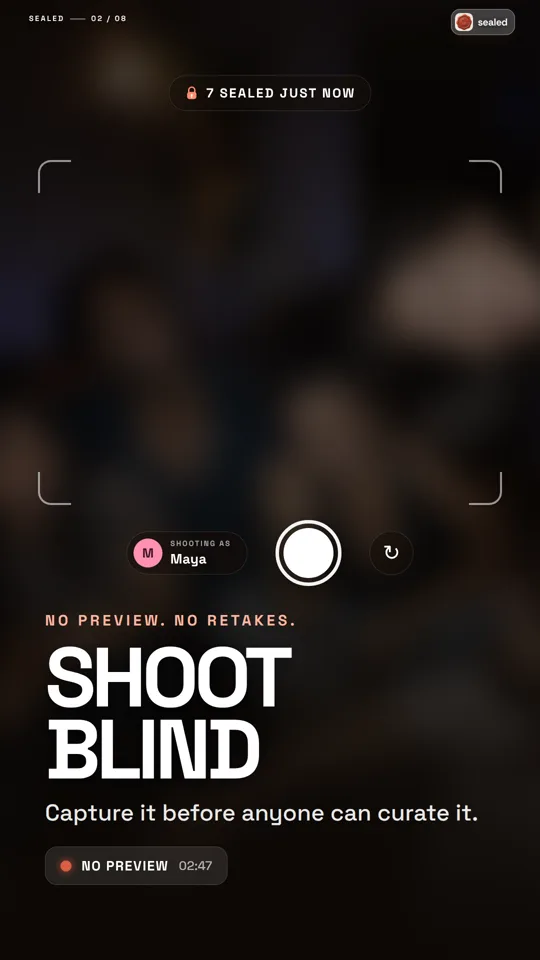
When people search for a disposable camera app with QR code, they are usually picturing the mechanics of an old-fashioned disposable camera translated into a phone: no live preview of what you've shot, and a way to hand the resulting photos to a group without everyone needing the same app installed ahead of time. The QR code part is the delivery layer. Instead of texting individual files or building a shared cloud folder, one code or link becomes the doorway the whole group walks through together.
This category sits between two older habits. One is the literal disposable camera, which forced patience because film had to be developed. The other is the group chat photo dump, which is instant but chaotic and rarely private beyond the people already in the thread. An app built around a QR code is trying to keep the patience of the first habit while making the handoff at the end easier than mailing a physical print or scanning negatives.
It's worth being precise about what the QR code does and doesn't solve. It solves distribution: getting a set of photos in front of a group without needing everyone's phone number or a shared login beforehand. It does not, by itself, guarantee that a reveal is delayed, that a gallery is private, or that everyone in the photos consented to being photographed. Those are separate design decisions an app has to make on top of the QR mechanic, and they vary between products.
Sealed's approach to shared reveal
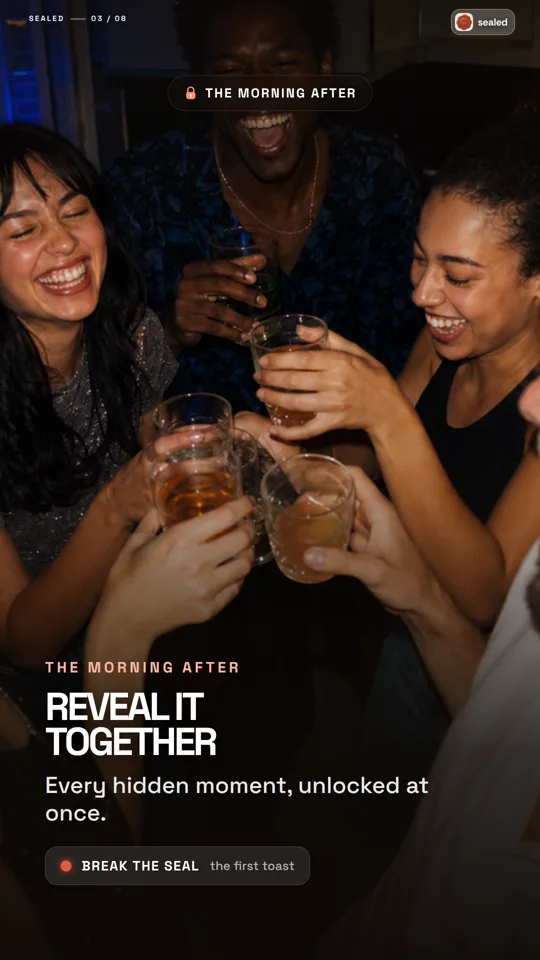
Sealed is a group photo capsule built around delayed, shared reveal - the idea, summarised plainly, is that everyone shoots, nobody peeks, and the group opens the photos together rather than one by one as they're taken. That's a specific editorial position, not a claim that every disposable camera app with QR code works this way. Some apps built around a QR code are closer to instant shared albums with no delay at all; the QR code is just a shortcut for joining, not a promise about when photos become visible.
Because Sealed's public site includes privacy, terms and child-safety information, and because editorial translations of the site don't guarantee the app interface or store listing matches in every language, anyone evaluating a specific app - Sealed included - should check the current store listing and in-app language before assuming availability. This article is not asserting that any particular app, including Sealed, has been tested here; it's describing the category and the questions worth asking.
The distinction that matters most for a reader trying to choose or use one of these apps is whether photos are held somewhere local to the event (a device or a temporary session) versus synced continuously to a cloud album that anyone can check mid-event. Sealed's own guide on this contrast - local photo capsule vs. cloud shared album - lays out that tradeoff directly: a cloud album tends to erode the delayed-reveal effect because people peek as soon as a photo lands, while a locally-held capsule is more likely to preserve the moment where nobody has seen anything until the group opens it together.
Consent and the QR code handoff
A QR code lowers the friction of joining a shared photo session, and that convenience cuts both ways. It's easy for someone to scan a code, start shooting, and photograph people nearby who didn't agree to be in the resulting shared gallery. The convenience of joining fast is exactly why consent deserves a deliberate moment rather than being assumed. People should have consent before photographing or sharing identifiable participants, and a QR-based tool doesn't change that responsibility - it just makes the technical part of joining faster, which can make the social part of asking feel like it can be skipped.
In practice, this means the person organizing a group photo session bears some responsibility for setting expectations before the QR code goes out: who's included, whether bystanders might end up in frame, and whether the resulting photos will be reveal-only for the group or shared more widely afterward. None of that is enforced by the QR code itself.
A reasonable habit is to treat the QR code as an invitation you narrate out loud - 'scan this and we'll all see the photos together later' - rather than a silent technical step. That single sentence does more for consent and expectation-setting than any interface design choice.
A worked example: using one at a small gathering
Here is a hypothetical, illustrative only, not a report of an actual event or test. Imagine six friends at a weekend dinner who want a shared photo ritual without the pressure of live previews. One person opens a session in a disposable-camera-style app, generates a QR code, and says out loud, 'Scan this if you want in - nobody sees anything until we open it together at the end.' Each guest scans, shoots a handful of photos over the evening, and nobody checks a shared feed mid-meal because there isn't one to check.
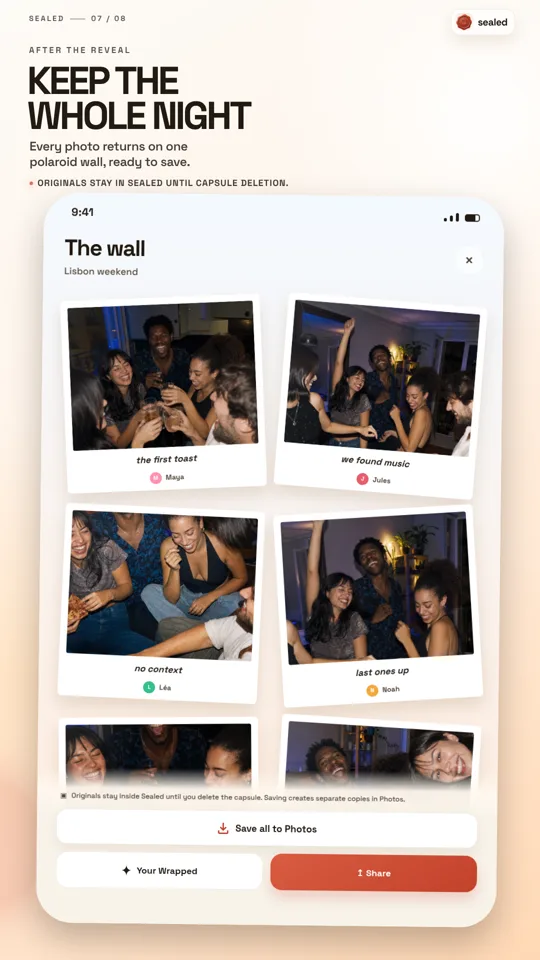
At the end of the night, the group opens the capsule together, ideally in one sitting, which mirrors the anticipation of picking up developed film. Because the organizer named the ritual explicitly and asked before including anyone outside the invited group, consent was handled as a conversation rather than an afterthought.
This hypothetical illustrates the four principles worth carrying into any tool in this category, regardless of brand: shared anticipation (the reveal happens together, not photo-by-photo), participant consent (asked, not assumed), minimal interruption (the camera doesn't demand attention mid-event), and thoughtful reveal (the moment of opening is treated as part of the experience, not just a settings toggle).
A short checklist before choosing an app
Because feature sets, pricing and store availability change over time and vary by app, a fixed checklist of questions is more durable advice than a list of app names or current feature claims.
This checklist is meant to be used at the moment someone is deciding whether a specific disposable camera app with QR code fits a particular gathering, not as a scoring system with a right answer.
- Does the app delay photo visibility until a defined reveal moment, or is it effectively a live shared album with a QR shortcut for joining?
- Where are photos held before the reveal - locally, or synced to a cloud service the moment they're taken?
- Does the app or its public site explain privacy, data retention and child-safety practices clearly, and can you find that information before committing a group to it?
- Is there a natural moment to ask participants and bystanders for consent before the QR code is shared, and does the app support that as a deliberate step rather than an instant join?
- Have you checked the current store listing for the specific app in your region and language, rather than assuming availability from a website or article?
Limits worth naming plainly
No article can promise that a given disposable camera app with QR code will behave a certain way in every version or region, because these apps are updated and their listings vary by market. General guidance here, including anything drawn from Sealed's own methodology and guides, describes intended design and public product information, not a guarantee of how any specific build performs for a specific reader.
This is also not legal, medical or investment advice, and it isn't a ranking of apps against each other. If a group's photos could involve minors, workplaces, or people who haven't explicitly agreed to appear, the safest approach is to slow down and ask directly rather than relying on any app's settings to handle that judgment call.
The practical takeaway is narrower than the marketing language around these apps often suggests: a QR code makes joining easy, a delayed-reveal design makes the ritual feel closer to a real disposable camera, and consent has to be handled by people, out loud, before either of those things matter.
Frequently asked questions
What does the QR code actually do in a disposable camera app?
It's a distribution shortcut that lets someone join a shared photo session without exchanging phone numbers or logins ahead of time. It doesn't by itself control whether photos are revealed instantly or held back for a group opening - that depends on the app's design.
Does a QR code mean the photos are private?
Not automatically. Privacy depends on how the app stores and shares photos after the scan, whether it syncs to a cloud album immediately, and what its stated privacy and retention practices are. Always check an app's own privacy and child-safety information before assuming photos are protected.
Who is responsible for getting consent when using one of these apps at a group event?
The people photographing and sharing are responsible for getting consent from anyone identifiable in the photos, regardless of what the app's technical settings allow. A QR code that makes joining fast doesn't remove the need to ask before including someone in a shared reveal.
Sources and further reading
These resources provide the wider reference frame. Product statements on this page are limited to the public information provided by Sealed.